Tuskers In Sri Lanka: Famous Wild And Temple Tuskers, Living And Lost
Sri Lanka's famous tuskers, from Agbo, Mahasen and Nandimithra in the wild to Nadungamuwa Raja of the Kandy Esala Perahera: where each one lives, which are still alive, which were lost and where to see tuskers today.
Written by Ashan Lokuge
Last updated on Published on

The most famous animals in Sri Lanka are its tuskers. A tusker is a male elephant with long, visible tusks, and so few of them survive on the island that nearly every one has a name, a fan page, and a spot on the evening news when he dies. This guide covers the well-known ones: wild tuskers still living, tuskers already lost, and the temple elephants that carry the Sacred Tooth Relic casket in Kandy.
Quick answer: Of the more than 7,000 wild elephants in Sri Lanka, only about 100 are tuskers. Among the best-known living tuskers are Agbo in Anuradhapura District, Mahasen around Minneriya and Kaudulla, Nandimithra in Yala, Mangala around Kala Wewa and Galgamuwa, and Sapumal around Minneriya and Kaudulla. The tallest of all, Kavantissa, died in October 2026. Nadungamuwa Raja, the most famous temple tusker, died in 2022 and is preserved today at the Natural History Museum in Colombo.
If you are planning a safari rather than reading about individual tuskers, begin with our guide to elephants in Sri Lanka. It covers the best parks, the Minneriya gathering, how elephants differ from tuskers and how to watch them ethically. A word on locations: for each tusker we name his home park or district and the parks he is known to visit, never exact spots. Poachers target many of these elephants.
What Makes A Tusker?
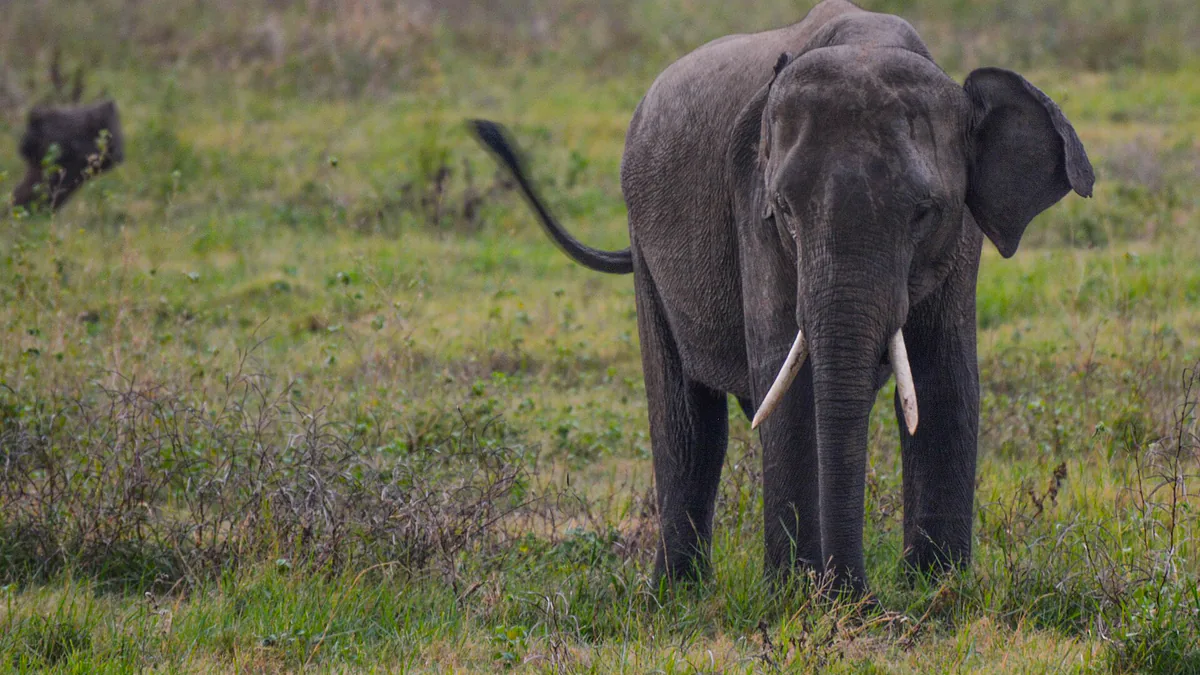
The word tusker means a male elephant that carries long tusks. These are upper incisor teeth, and they never stop growing while he lives. Just 7.5% of Sri Lankan males develop them. The others end up with short tushes, or with nothing, and tuskless females are the norm. A tusker goes by the Sinhala name ætha; an elephant without tusks is called an aliya. Tuskers are not a breed of their own. Scarcity, body size and ivory are the reasons they are respected, and also the reasons poachers want them.
How Many Tuskers Are Left In Sri Lanka?
Ask for an exact figure and nobody can give one. Ask for a rough one and the answer is always low. The 2011 national elephant count recorded 122 tuskers. Wild Tuskers Srilanka is a group of wildlife photographers who have tracked individual tuskers over about ten years. In that time they have identified around 300, and their belief is that about 100 remain in the wild, according to Mongabay's November 2026 report on Sri Lanka's high-risk tuskers.
This group also scored 55 tuskers for the threats facing them. One factor was how much their range overlaps with farms and villages. Of those, 17 came out as high risk, and the tuskers named on the list include Agbo, Wasala, Mahanama, Kashyapa, Suranimala, Sumedha, Surya, Maha, Mahasena, Deegabhaya, Gajabahu and Wanniyan. Highest was Agbo at 96.7%, then Wasala at 95%. The old home range of Kavantissa is close to where both of them roam. Profiles of each named tusker follow below.
The government's answer was Hasthi Sena, a joint operation involving the army, navy, air force and the Department of Wildlife Conservation. It exists to guard the listed tuskers and to raid areas where trap guns, wire snares and explosive bait are set. Military protection covers 13 tuskers at first, the Sunday Times reported in October 2026.
Where To See Tuskers In Sri Lanka
Nobody can guarantee you a tusker on safari. The north central dry zone parks give you the best odds, since that is where most named tuskers live. Yala and Udawalawe in the south are the other options. Book several drives rather than one, choose the late afternoon slot when bulls come down to the water, and ask your jeep driver which tuskers have turned up that week.
| Park or area | Named tuskers seen there | Best months |
|---|---|---|
| Kala Wewa and Galgamuwa | Mangala, Vijaya, Ananda, Ratta, Raghu, Esala II | June to October |
| Minneriya, Kaudulla and Hurulu Eco Park | Mahasen, Sumedha, Sapumal, Esala II | July to December |
| Yala National Park | Nandimithra, Gemunu, Sando | February to August |
| Udawalawe National Park | Bullet (Senadhi) | All year |
| Wilpattu National Park | Deegabhaya | February to October |
| Bundala National Park | Kashyapa | All year |
A few hours' drive separates Kala Wewa, Minneriya and Wilpattu. Spend a few days with a private driver in Sri Lanka and you can work through several tusker parks on a single trip, timing each safari for the afternoon.
Famous Wild Tuskers Living Today
Trackers, photographers and park rangers in Sri Lanka follow the wild tuskers closely, and most of them go by a name. Below is a table of the best-known living tuskers, with the latest news we could find for each as of November 2026. For every tusker we give the home park or district plus the other parks he is known to visit. We stop short of exact locations. Several of these elephants are targets for poachers.
| Tusker | Status (latest report) | Home area | Also seen in | Known for |
|---|---|---|---|---|
| Agbo | Alive, found safe on 19 October 2026 | Anuradhapura District | Nachchaduwa reservoir reserve | Highest risk score on the 2026 list, survived gunshot wounds in 2023 |
| Wasala | Alive, filmed in May 2026 | Puttalam District | Near Kavantissa's old range | Second highest risk score (95%) |
| Mahasen | Treated for gunshot and fight wounds in January 2026; not seen for over eight months by November 2026 | Minneriya and Kaudulla | Somawathiya, Maduru Oya | Thought to carry the largest tusks of any known wild tusker |
| Nandimithra | Alive, December 2023 | Yala National Park | Sithulpawwa forests | Took Gemunu's last tusk, pushes his trunk into jeeps for food |
| Gemunu | Seen in news video, January 2026 | Yala National Park | Block 1 jeep tracks | Raided safari jeeps for food, lost both tusks in fights |
| Sando | Not seen since October 2024, unconfirmed | Yala National Park, Block 2 | Block 1 during musth | Chasing safari jeeps |
| Sumedha | Injured, tusk broken by a truck, March 2025 | Minneriya area | Minneriya National Park | On the 2026 high-risk list |
| Gajaba | Filmed in November 2026, under security forces' protection | Not published | Not published | Described in 2020 as the largest wild tusker in Sri Lanka |
| Mangala | Alive, filmed in Galgamuwa in July 2026 | Kala Wewa | Galgamuwa, during musth | Revatha's old companion, survived a gunshot as a young tusker |
| Vijaya | Alive, filmed in January 2026 | Kala Wewa | Galgamuwa | Young tusker seen as one of Galgamuwa's next big bulls |
| Sumana (Suman) | Disputed: reported shot in July 2025, named as living in October 2026 | Galgamuwa | Not published | One of the Galgamuwa tuskers villagers asked the government to protect |
| Manabarana | Filmed with a herd in September 2025 | Not published | Not published | Known mainly from wildlife videos |
| Ananda | Alive, filmed in May 2026 | Galgamuwa | Arrived from neighbouring forests | Young tusker, with Vijaya one of Galgamuwa's rising bulls |
| Ratta | Alive, October 2026 | Galgamuwa | Not published | Dominant bull; fought Raghu in April 2025, linked to Chandi's death |
| Raghu | Alive, October 2026 | Galgamuwa | Not published | Single right tusk, seen with large herds |
| Missaka | Alive, October 2026 | Galgamuwa | Not published | About 50 years old |
| Bhagya | Alive, October 2026 | Galgamuwa | Not published | Named by villagers; nothing else published |
| Sapumal | Shot in September 2025, filmed healthy in August 2026 | Hurulu Eco Park, Minneriya and Kaudulla | Kaudulla tank | Young tusker who survived two gunshot wounds |
| Kashyapa | Alive, on the 2026 high-risk list | Bundala National Park | Hambantota District | Elusive tusker of the southern coast |
| Gajabahu | Alive, on the 2026 high-risk list | Northern Anuradhapura District | Padaviya and Wahalkada forests | Looks so much like Agbo that people ask if they are related |
| Surya | Alive, on the 2026 high-risk list | Anuradhapura District | Wilachchiya area | Elusive and aggressive |
| Deegabhaya | Alive, filmed in October 2026 | Wilpattu National Park | Not published | On the 2026 high-risk list |
| Suranimala | Alive, on the 2026 high-risk list | Not published | Not published | Known for walking village roads at night |
| Wanniyan | Alive, on the 2026 high-risk list | The Vanni | Not published | Lived through the civil war years |
| Esala II | Alive, filmed in November 2026 | North central dry zone | Minneriya, Kala Wewa | Young tusker, often seen with Mangala |
| Mahanama and Maha | On the 2026 high-risk list | Not published | Not published | No other published details |
| Bullet (Senadhi) | Last reported 2019 | Udawalawe National Park | Udawalawe reservoir fence | Rescued as a calf with a bullet wound, raised at the Elephant Transit Home |
Agbo, Anuradhapura District
Few giant tuskers remain in the north central dry zone, and Agbo is one of them. He measured about 10 feet and was nearly 40 years old when he first made the news in 2023. A trap gun injured his left front leg that year, and October brought another shooting. Wildlife vets spent months treating him and feeding him by hand. He lived, but the care made him used to people, and he started walking into villages. His score of 96.7% puts him at the top of the 2026 high-risk list. In October 2026 he went missing, the army joined the search, and on 19 October he was found safe and healthy in the Nachchaduwa reserve.
Wasala
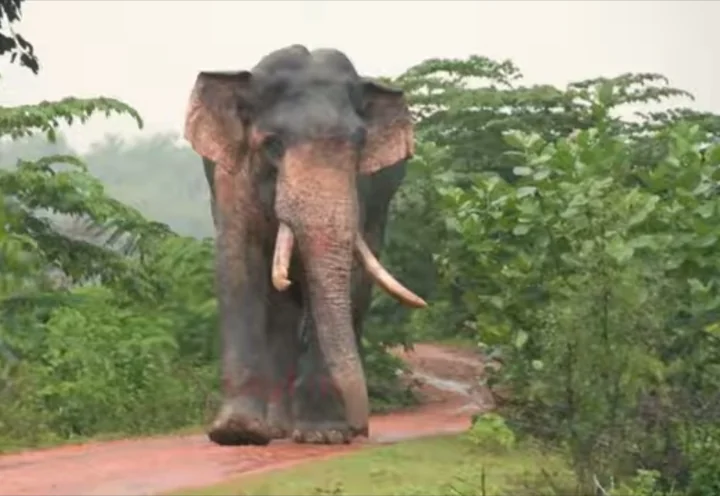
With 95% on the 2026 risk assessment, Wasala came second, behind Agbo alone. His range, like Agbo's, sits close to the old home range of Kavantissa. He was first recorded in 2020, and a wildlife film-maker has followed him ever since. That film-maker filmed him in Puttalam District in May 2026 and calls him one of the most aggressive tuskers on the island. Beyond that, published detail is thin. Which is probably the safest outcome for him.
Mahasen, Minneriya And Kaudulla
Ask many Sri Lankans to name a tusker and Mahasen comes first. His tusks curve in and overlap at the tips, the mark of a cross-tusker, and Mongabay described him in 2020 as carrying the largest pair of tusks of any known wild tusker alive. Outside the peak of musth he is shy and rarely seen. According to a wildlife vet, speaking in 2017, he usually turns up at Minneriya around April and otherwise moves through Kaudulla, Somawathiya and Maduru Oya. After seven years without a sighting, Hiru News filmed him at Somawathiya in June 2022. Gunshot wounds have hit him several times and not killed him. In January 2026 Hiru News reported a tusker named Mahasen under treatment for gunshot wounds and injuries from a fight with another tusker. More than eight months passed with no sighting, Mongabay reported by November 2026. A Mahasena on the 2026 high-risk list is probably the same elephant.
Nandimithra, Yala
Nandimithra's home is the forest around Sithulpawwa, inside Yala. He fought Gemunu in January 2020 and broke off Gemunu's remaining tusk. The rangers remember him for another reason. His trunk got stuck in the fork of a tree in January 2017, and they freed him. Jeeps carry food, and he has learned it, just as Gemunu did before him. The park warden asked visitors in December 2023 not to feed him, because he pushes his trunk into vehicles.
Gemunu, Yala
The warrior king Dutugemunu gave Gemunu his name, and Yala gave him fame. What made him famous was walking up to safari jeeps and searching them for food. His first tusk went in February 2018, lost in a fight with the tuskers Sando and Parakum. His second went to Nandimithra in 2020. Swarnavahini reported in March 2025 that illegal firecrackers were being used to drive him off. In January 2026 the Daily Mirror published a video of him striking a tourist jeep. He appears to be alive, now without tusks.
Sando, Yala
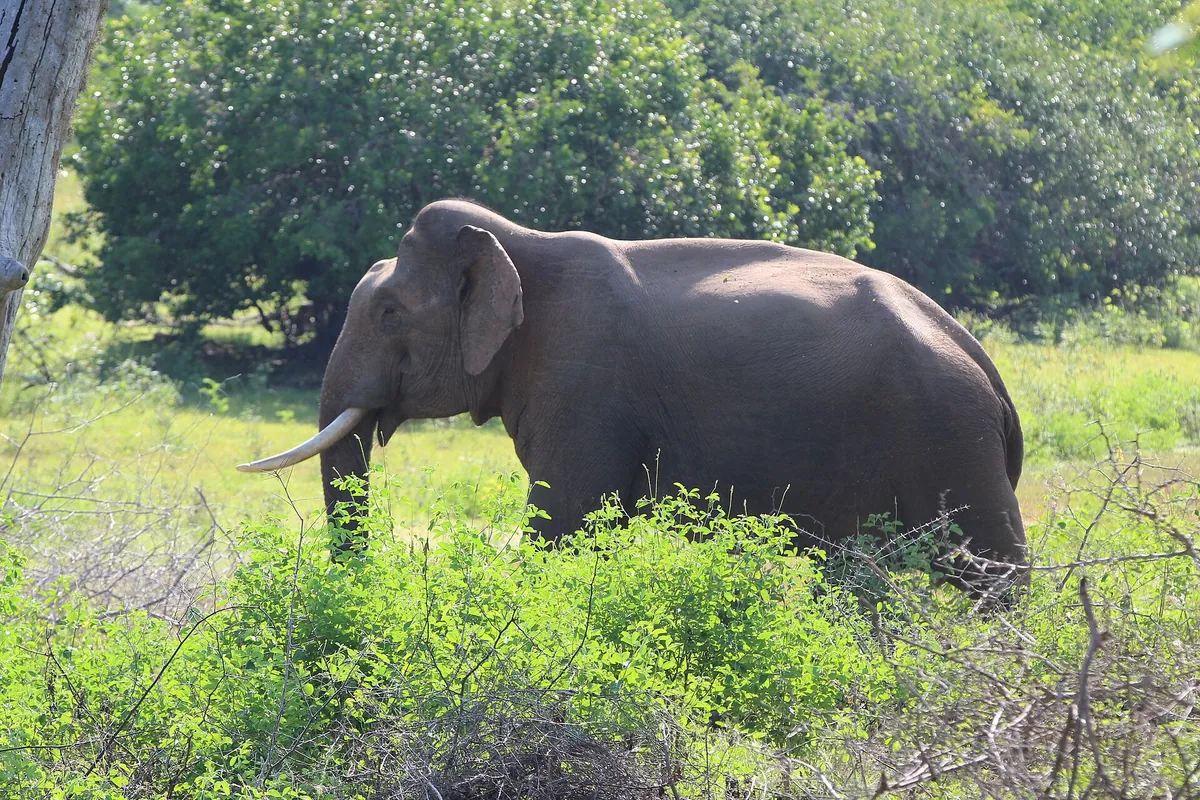
Yala's Block 2 is home ground for Sando. Musth is what pushes him into the busier Block 1, and jeep chasing is what he does there. October 2024 was his last sighting. The carcass found in February 2025 turned out to belong to a younger elephant. At our latest check, no official word had settled the question of whether Sando is alive.
Sumedha, Minneriya
Sumedha is a Minneriya tusker listed as high risk on the 2026 list. A speeding truck broke off one of his tusks in early 2025, a piece roughly 1.5 metres long. Koliya and Unicorn, two young tuskers from his area, were each shot within months, in 2024 and 2025.
Gajaba
Mongabay called Gajaba the largest wild tusker in Sri Lanka in 2020. He stands about 3.1 metres at the shoulder. The area he lives in has little safe habitat left. His range has not been published. New camera footage of him appeared on Hiru News in November 2026, along with a report that security forces had been assigned to protect him.
Mangala, Kala Wewa And Galgamuwa
The Kala Wewa area is where Mangala grew up, often in the company of the old tusker Revatha. Villagers were alarmed to find the two of them near their homes, and Newsfirst filmed them in December 2020. Revatha was killed in 2021, and Mangala carried on alone. Farmers shot him while he crossed fields, a wildlife channel reported in 2020, and he survived. Kala Wewa has become harder for elephants in recent years, wildlife film-makers say, and he has moved more and more into the Galgamuwa forests, especially during musth when he comes looking for females. Galgamuwa villagers named him in October 2026 among the tuskers they want the government to protect.
Vijaya, Kala Wewa And Galgamuwa
Vijaya has come from Kala Wewa into Galgamuwa, as Mangala did, and he is younger. Local wildlife film-makers have followed him since at least 2024. Kavantissa, then still the dominant bull in Galgamuwa, was filmed warning Vijaya off in October 2025. In January 2026 those film-makers called Vijaya and another tusker, Ananda, Galgamuwa's next tusker kings. Kavantissa is gone, so Vijaya is one of the bulls to watch in the area, though we found no news reports about him yet.
Sumana (Suman), Galgamuwa
These elephants are difficult to track, and Sumana proves the point. A tusker "believed to be Suman", known around the area for years, was reported by the Daily Mirror on 22 July 2025 as found shot dead in the Galgamuwa area. That came days after Bathiya died. Yet in October 2026, once Kavantissa had died, Galgamuwa villagers named Sumana among the living tuskers they want protected, next to Bhagya, Missaka, Raghu, Mangala and Ratta. Two explanations fit: the dead tusker was a different elephant, or the name is shared. No official answer has turned up.
Manabarana
Most of what is known about Manabarana comes from wildlife videos. A local channel filmed him with a herd in September 2025, hemmed in near a village. With no news reports to go on, we cannot say where he usually lives. Barana of Kala Wewa, killed in 2022, is a different elephant.
Ananda, Galgamuwa
Ananda is a young tusker. He reached the Galgamuwa area in the last couple of years, and the wildlife film-makers who follow him say he joined Kavantissa's herd and quickly showed his temper. In January 2026 they named him and Vijaya as Galgamuwa's next tusker kings.
Ratta And Raghu, Galgamuwa
Ratta ranks among Galgamuwa's dominant bulls. Chandi died after a fight in July 2024, and Rupavahini News raised the question of whether Ratta had been his opponent. No official source has confirmed that. Newsfirst filmed Ratta in a long fight with Raghu, another Galgamuwa tusker, in April 2025. Raghu carries a single tusk on the right side. He appears beside Kavantissa and Chandi in a Mongabay photo of the area's tuskers. Both were named on the list of Galgamuwa tuskers villagers asked the government to protect in October 2026.
Missaka And Bhagya, Galgamuwa
That list of Galgamuwa tuskers villagers named in October 2026 ends with Missaka and Bhagya. A local wildlife channel gives Missaka's age as about 50. A Yala tusker of the same name, which died in 2018, is not him. About Bhagya, nothing beyond the name has been published.
Sapumal, Hurulu, Minneriya And Kaudulla
Sapumal is young, about 25, and his range takes in Hurulu Eco Park, Minneriya and Kaudulla. Filmed limping near the Kaudulla tank in September 2025, he had two gunshot wounds to his right front leg, and Ada Derana reported his condition as critical. No official follow-up appeared. Wildlife film-makers did post footage of him bathing at Kaudulla in August 2026, apparently healthy.
Kashyapa, Bundala
Few south coast tuskers have names, and Kashyapa, also written Kassapa, is one of them. His range is Bundala National Park in Hambantota District and the land around it. Wildlife film-makers call him hard to find. He appears on the 2026 high-risk list.
Gajabahu, Northern Anuradhapura District
Northern Anuradhapura District is where Gajabahu lives, in the forests around Padaviya and Wahalkada. Agbo and he look so alike that Rupavahini News asked in 2023 whether there was a family link. The 2026 high-risk list includes him. Gajaba, the elephant described as the largest wild tusker, is not the same animal.
Surya, Anuradhapura District
Surya, an elusive tusker, lives in the Wilachchiya area of Anuradhapura District, near Wilpattu. Film-makers who searched for him called him aggressive and rarely seen. He is listed on the 2026 high-risk list.
Deegabhaya, Wilpattu
Deegabhaya is a Wilpattu tusker on the 2026 high-risk list. Wilpattu safari guides filmed him in the park in October 2026.
Suranimala
The 2026 high-risk list includes Suranimala. His range has never been published. What wildlife channels have filmed him doing is walking village roads at night and raiding plantations, the kind of behaviour that lands tuskers in danger.
Wanniyan, The Vanni
Wanniyan's name comes from the Vanni, the northern region where much of the civil war was fought. Wildlife film-makers say he survived those years in the forest and was found once the war ended. The 2026 high-risk list includes him.
Esala II, North Central Dry Zone
A young tusker of the north central dry zone, Esala II has been filmed at Minneriya and Kala Wewa, and Mangala often appears alongside him. Wildlife channels reported in August 2025 that one of his tusks had broken. Newsfirst reported an "Asala" tusker re-sighted at Minneriya in August 2026, possibly the same elephant.
Mahanama And Maha
Mahanama and Maha are both listed as high risk on the 2026 list. Where they live has no reliable published record, and that may be deliberate.
Bullet (Senadhi), Udawalawe
Bullet was found as a calf, a bullet lodged near his jaw. The Udawalawe Elephant Transit Home raised him, and he went into Udawalawe National Park in the early 2000s. As he grew he became a striking tusker, his long tusks almost crossing. He became known for waiting at the park's electric fence to be fed. Wildlife officers discourage this.
Famous Wild Tuskers That Have Died
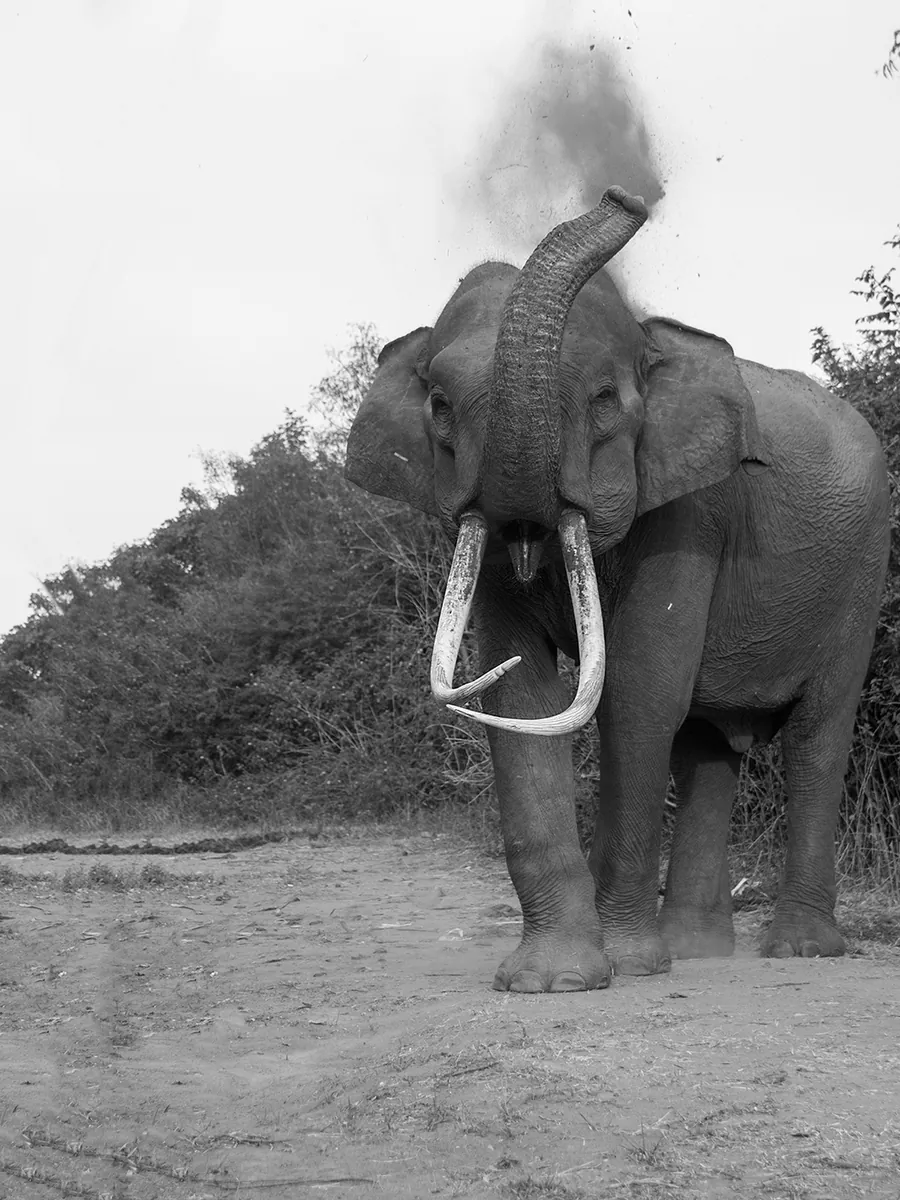
A famous wild tusker has died in Sri Lanka in almost every year. The best-documented losses are listed below. Old age was not the cause for most of them.
| Tusker | Died | Home area | Cause as reported |
|---|---|---|---|
| Kavantissa | 16 October 2026 | Galgamuwa, also Kala Wewa | Gunshot wound to the right foreleg; exact cause disputed |
| Mahasilu | Found 11 September 2025 | Buttala and Okkampitiya, Monaragala District | Not determined |
| Kandalame Hadakaraya | 13 August 2025 | Kandalama reservoir, Matale District | Gunshot wound, died after six months of treatment |
| Bathiya | 15 July 2025 | Kala Wewa and Polpithigama | Gunshot wound to the right front leg |
| Unicorn | March 2025 | Minneriya National Park | Shot |
| Koliya | Found December 2024 | Minneriya National Park | Shot, per Mongabay; local TV called it mysterious |
| Deega Danthu 1 | 27 November 2024 | Kala Wewa National Park | Illegal electric fence |
| Chandi | 5 July 2024 | Galgamuwa | Fight with another tusker |
| Thekka Raja | Around mid 2023 (date not reported) | Galgamuwa | Not reported |
| Barana (Bharana) | 26 July 2022 | Kala Wewa, Galkiriyagama reserve | Illegal power line |
| Revatha | 9 March 2021 | Kala Wewa and Balalu Wewa reserve | Illegal electric fence around a maize field |
| Mugalan | 2018 | Udawalawe National Park | Shot near sugar cane fields |
| Dala Poottuwa | Late 2017 | Galgamuwa | Shot by poachers, tusks seized |
| Thilak | June 2017 | Yala National Park | Fight with another elephant |
| Wasantha | 2014 | Wilpattu National Park | Shot by a poacher |
| Parakrama | 23 November 2010 | Galgamuwa | Injured during a relocation |
| Podi Poottuwa | 1986 | Yala National Park | Killed for his tusks |
| Maha Poottuwa | Disappeared in the 1990s | Yala National Park | Unknown |
Kavantissa (Kawanthissa), Galgamuwa
People described Kavantissa as the tallest elephant on the island, roughly 11 feet in height, with tusks measuring more than 6 feet and an age of somewhere between 50 and 60. Trackers first noted him in 2008, and in 2015 they gave him the name of King Kavan Tissa. His home was around Galgamuwa and the Kala Wewa reserve, often near farmland, and no one ever recorded him harming a person.
Wildlife officers found a gunshot wound in his right front leg in late September 2026. They treated him where he stood for about three weeks. He went down in a paddy field and died on the evening of 16 October 2026. Two suspects were arrested and remanded over the shooting. What killed him remains disputed. Officials have pointed to the gunshot and possible poisoning, while other reports questioned his treatment. We have not stated a cause. After his death, the high-risk list and the Hasthi Sena operation moved to the top of the government's agenda.
Bathiya, Kala Wewa
Bathiya was young and well-proportioned, aged 30 to 35, and wildlife photographers loved him. He lived around Kala Wewa and Polpithigama. A shot to the right front leg in May 2025 was followed by a fall into a water pit. A veterinary team treated him for two months. He died on 15 July 2025, Ada Derana reported.
Mahasilu, Monaragala District
Mahasilu was a young tusker carrying two well-grown tusks. Buttala and Okkampitiya in Monaragala District, on the way between Ella and Yala, were his range. A paddy field is where he was found dead, on 11 September 2025. The wildlife office opened a special investigation. No cause has been published.
Kandalame Hadakaraya, Kandalama
A young tusker of 25 to 30, Kandalame Hadakaraya lived around the Kandalama reservoir in Matale District, close to Dambulla and its hotels. Several times over the years he had been shot. Wildlife vets treated a gunshot wound to a front leg for more than six months. He died on 13 August 2025, Ada Derana reported.
Unicorn And Koliya, Minneriya
Months apart, two young Minneriya tuskers were lost. Koliya, often seen with the bigger tusker Sumedha, died in 2024. His decomposed body turned up in December that year, and Mongabay reported he had been shot, though local TV called the death mysterious. Unicorn, named for his single tusk, was found shot dead on 17 March 2025. Those two deaths prompted Mongabay's March 2025 report on Sri Lanka's vanishing tuskers. In it, wildlife photographers warned that the big tuskers were "falling like dominoes".
Deega Danthu 1, Kala Wewa
At Kala Wewa, no elephant carried longer tusks than Deega Danthu 1, whose name means "long tusks". He was 45 to 50 and had survived a trap gun wound to his leg in 2018. A twin, Deega Danthu 2, is still seen in the park. An illegal fence electrocuted him on 27 November 2024. His case has gone further than most. In June 2026 his tusks were dug up as evidence, and the Daily Mirror reported that prosecutors were seeking the first ever charges under the Public Property Act over an elephant's death.
Revatha, Kala Wewa
The Kala Wewa and Balalu Wewa reserve had no older or more dominant tusker than Revatha, about 50 years old, and no record of him attacking anyone exists. A maize field ringed by an illegal electric fence killed him in March 2021.
Barana (Bharana), Kala Wewa
Photographers knew Barana as a bull that never harmed anyone, and he was among the most photographed tuskers around Kala Wewa, with tusks about four feet long. The mating season was when he came to the Kala Wewa area. An illegal power line in a reserve near Galkiriyagama killed him on 26 July 2022, and police later arrested suspects, the Daily Mirror reported. Barely a year had passed since Revatha's death, in the same tusker country.
Chandi, Galgamuwa
Chandi was a Galgamuwa bull with one tusk. Local accounts say more than one attempt was made to move him away, and each time he found his way back home. A fight with another tusker ended his life beside a lake in Galgamuwa on 5 July 2024.
Thekka Raja, Galgamuwa
Thekka Raja, a Galgamuwa tusker, died within a month of being treated by wildlife vets, at the place where they treated him. Footage from July 2023 shows him being found in the forest, which suggests his death came around then. No date or cause has been published. After Kavantissa died in 2026, campaigners cited him among the deaths.
Dala Poottuwa, Galgamuwa
Villagers treated Dala Poottuwa, the crossed tusker of Galgamuwa, almost like a pet, and his eyesight was poor. In November 2017 a pair of tusks with his unusual curve was seized. His carcass was found later. A court heard in 2018 that DNA from the remains matched the seized tusks. His killing became one of the best-known ivory cases in modern Sri Lanka.
Thilak, Yala
Thilak was among the oldest and largest tuskers in Yala, about 55 years old. His heavy tusks curved inwards, and his temper was gentle. The park entrance was where he spent his last years, and he died after a fight with another elephant in June 2017.
Mugalan, Udawalawe
Mugalan was a young Udawalawe tusker, only about 12. In December 2018 he was found shot dead near the Udawalawe tank, inside the park boundary, killed with a muzzle-loading gun. Even inside Sri Lanka's best-known elephant park, a tusker is not safe.
Wasantha, Wilpattu
Wasantha was a docile, shy tusker of Wilpattu National Park and the land around it, possibly partly blind in one eye. A poacher shot him in 2014, and the poacher was caught. Wilpattu's elephants are seen less often than those in the Cultural Triangle parks, and he is one of the few named Wilpattu tuskers in the press.
Parakrama, Galgamuwa
Many considered Parakrama, also called the Siyambalangamuwa tusker, the most spectacular wild tusker of his time. His long, symmetrical tusks almost reached the ground. A disputed case blamed him for a fisherman's death, and in November 2010 he was captured for relocation. He died that night after his leg went through the floor of the transport truck.
Maha Poottuwa And Podi Poottuwa, Yala
The most photographed elephants in Yala in the 1970s were its two famous cross-tuskers, the "big crossed one" and the "small crossed one". Podi Poottuwa was killed for his tusks in 1986. Maha Poottuwa, first seen in the late 1950s, disappeared in the 1990s. Crossed tusks are still seen mainly in the Yala and Kumana area.
Famous Temple Tuskers Of Sri Lanka
Temple tuskers are captive elephants, owned by temples, devalayas, families or the state. Carrying the golden casket of the Sacred Tooth Relic in the Kandy Esala Perahera is the job of the most honoured among them. Others carry relics in peraheras elsewhere, such as Kelaniya's Duruthu Perahera and Gangaramaya's Navam Perahera in Colombo. Ten elephants make up the Temple of the Tooth's own fleet today: Indi Raja, Sinha Raja, Buruma Raja, Myan Raja, Janaraja, Migara, Vijaya Raja, Sindu, Raju and Pulathisi Raja. Other countries gifted several of them.
| Tusker | Owner | Where he came from | Known for | Status |
|---|---|---|---|---|
| Raja (Maligawa Raja) | Temple of the Tooth | Captured near Eravur, Batticaloa, 1925 | Casket bearer for 37 years, national treasure | Died 1988, preserved at the temple |
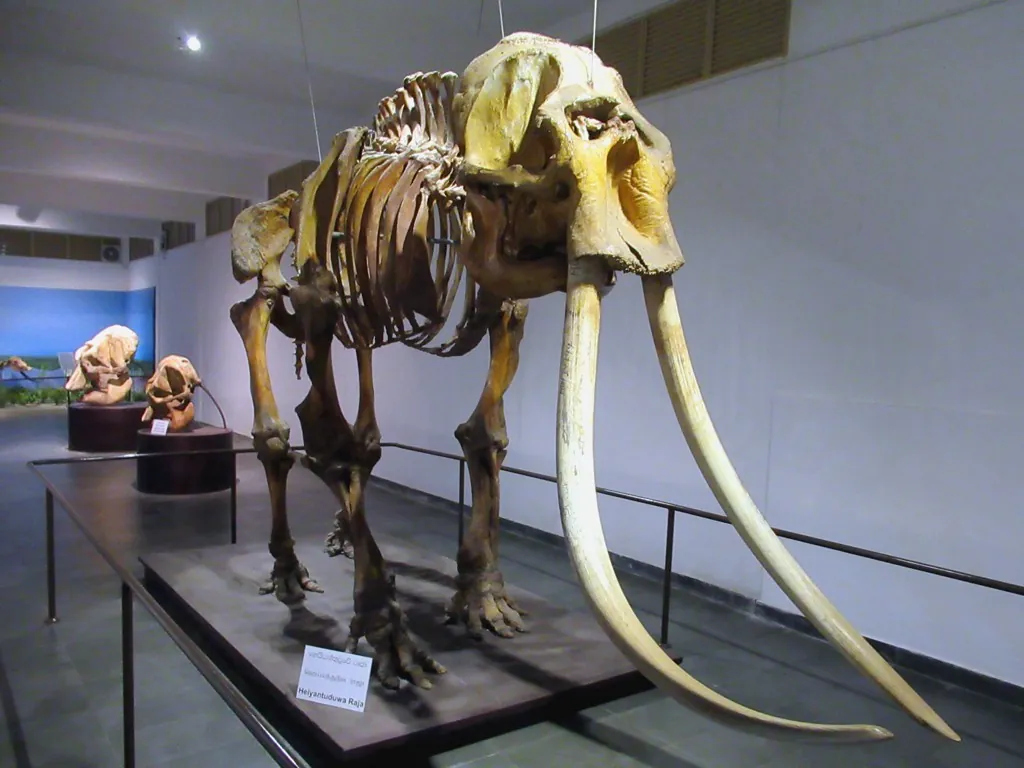
| Heiyantuduwa Raja | Gunasekara family, Biyagama | Captured near Hambantota, sold 1945 | Casket bearer in the 1990s, 7 ft 6 in tusks | Died 2002, skeleton in Colombo |
| Millangoda Raja | Millangoda family | Not recorded | Among the longest tusks of any captive elephant | Died 2011, preserved near Kegalle |
| Nadungamuwa Raja | Nadungamuwa family | Mysore, India | Main casket bearer 2005 to 2021 | Died 2022, preserved in Colombo |
| Indi Raja | Temple of the Tooth | Gift from India, 1988 | Main casket bearer after 2022 | Alive, ill in 2026 |
| Sinha Raja | Temple of the Tooth | Rescued from a war zone by the army, 1994 | Carried the casket in 2026 | Alive |
| Janaraja | Temple of the Tooth | Gift from President Jayewardene, 1985 | Carried the casket in 2026 after 25 years | Alive |
| Pulathisi Raja | Temple of the Tooth | Gift from Myanmar, 2017 | Carried the casket in 2026 | Alive |
| Kataragama Wasana | Ruhunu Maha Kataragama Devalaya | Found as a calf in Anuradhapura District | Carried the casket in 2025 and 2026 | Alive, about 58 |
| Vijaya Raja (Thai Raja) | Temple of the Tooth | Gift from the King of Thailand | Thai campaign to bring him home | Alive |
| Kandula | Kelaniya Raja Maha Viharaya | Gift from Thailand, 2001 | Duruthu Perahera, Kandy casket in 2023 | Alive |
| Buruma Raja and Myan Raja | Temple of the Tooth | Gifts from Myanmar, 2007 | Walk beside the casket tusker | Alive |
| Millangoda Podi Raja | Millangoda family | Bought at a Dehiwala Zoo auction, 1956 | Carried the casket in 2017 | Died 2020 |
| Navam Raja and Ruwan Raja | Gangaramaya, Colombo | Mysore calf; Ratnapura gift | Navam Perahera, Kandy casket | Died 2011 and 2003 |
| Muthu Raja | Kande Viharaya, Aluthgama | Gift from Thailand, 2001 | Flown home to Thailand in 2023 | Alive, in Thailand |
Raja, The Maligawa Tusker (About 1913 To 1988)
Sri Lankan history has no more famous elephant than Raja. His birth came around 1913 near Eravur in Batticaloa District. Captured in 1925, he was bought by Mampitiya Disawe of Giragama Walauwa, who gifted him to the Temple of the Tooth in 1937. The role of main casket bearer was his from 1950, and for 37 years he carried the casket in the final Randoli procession. In 1986 President J. R. Jayewardene declared him a national treasure. A postage stamp followed in 1989. His death on 16 July 1988 brought a government-declared national day of mourning. His preserved body stands in the Raja Museum in the Temple of the Tooth grounds in Kandy, and most visitors walk past it on the way out of the temple.
Heiyantuduwa Raja (About 1924 To 2002)
The Kattakaduwana forest near Hambantota is where Heiyantuduwa Raja was captured. At auction in 1945 the Gunasekara family of Heiyantuduwa, near Biyagama, bought him, and he stayed with them for the rest of his life. Each tusk measured about 7 feet 6 inches. Once Raja had died, he took over as the Kandy casket bearer for most of the 1990s, though sources give slightly different years. Relics also went with him to the Kelaniya Duruthu, Bellanwila and Gangaramaya Navam peraheras. He died on 6 November 2002, aged about 78. In 2004 his owner gave the tusks and skeleton to the National Museum, and in January 2013 the skeleton went on show at the National Museum of Natural History in Colombo.
Millangoda Raja (About 1938 To 2011)
Millangoda Raja was a temple tusker. His tusks, about 7 feet 6 inches (2.3 metres), ranked among the longest of any domesticated Asian elephant. He stood over 9 feet tall. For about a decade he served as one of the main casket bearers of the Kandy Esala Perahera, and his last walk in the procession came in 2008. He died in Kegalle in July 2011. His preserved body is on display at a museum in the elephant village at Molagoda, near Kegalle.
Nadungamuwa Raja (About 1953 To 2022)
Mysore, India, was Nadungamuwa Raja's birthplace, and he became the best-known elephant in Sri Lanka. He stood about 10.5 feet (3.2 metres) and served as the main casket bearer of the Kandy Esala Perahera from 2005 to 2021. The government declared him a national treasure after his death in March 2022. In March 2026 his preserved body went on public display at the Natural History Museum in the Colombo National Museum grounds.
Indi Raja
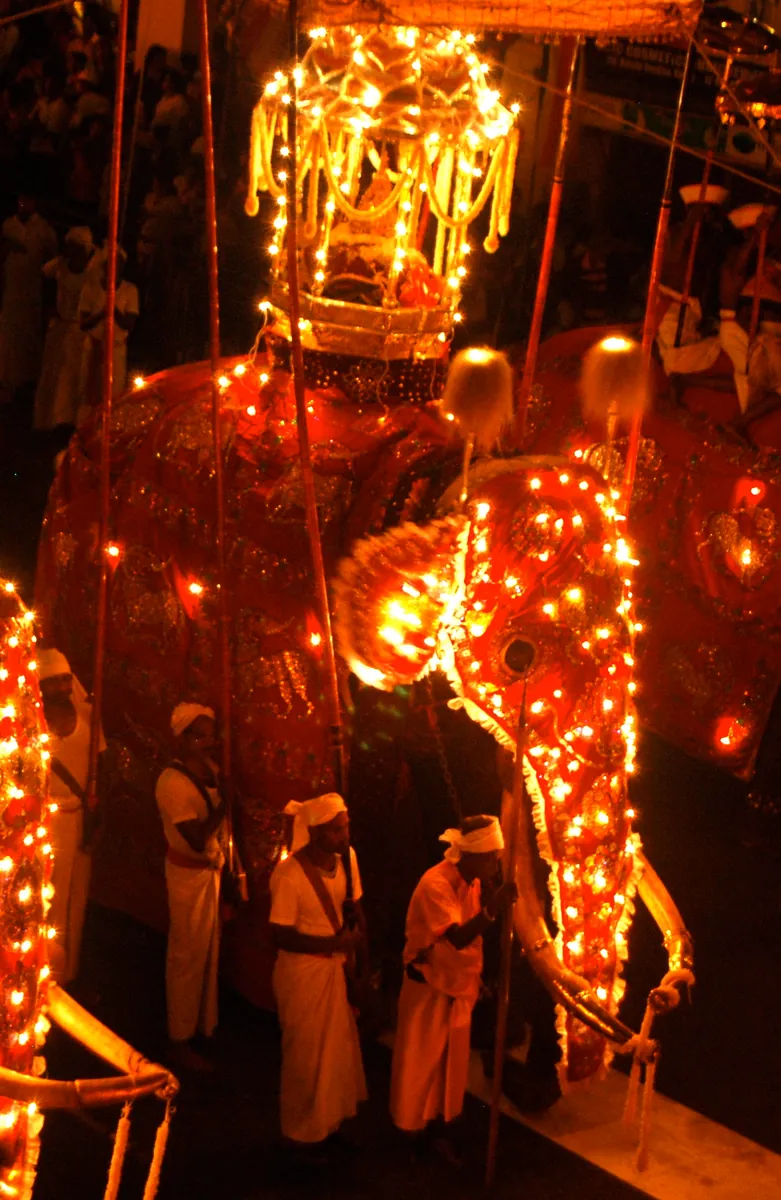
Indi Raja was born in India around 1980. In 1988 Indian Prime Minister Rajiv Gandhi gave him to President J. R. Jayewardene, for the Temple of the Tooth. His first turn carrying the main casket came in 2009. After Nadungamuwa Raja died, he took over as the main casket bearer. Illness hit him before the Perahera in 2026, and other tuskers carried the casket in his place. Among them were the temple's own tusker Janaraja and the Kataragama tusker Wasana.
Sinha Raja
Sinha Raja was a calf, separated from his herd in a war zone, when soldiers of the army's Sinha Regiment found and rescued him. They gave him to the Temple of the Tooth in 1994. The temple names him as the tusker that now has the privilege of carrying the casket, and in the 2026 perahera he carried it on the second and third Randoli nights.
Janaraja
Janaraja lived at Dehiwala Zoo before President J. R. Jayewardene gave him to the Temple of the Tooth in 1985. His name marks Sri Lanka becoming a republic. He is one of the most senior tuskers in the temple's fleet. With Indi Raja ill on 19 August 2026, he carried the casket on the second Kumbal night, his first time in 25 years, with Myan Raja and Sinha Raja on either side.
Pulathisi Raja
A gift from Myanmar, Pulathisi Raja (also spelled Pulasthi Raja) reached Sri Lanka on 18 August 2017, aged about 21. That September President Maithripala Sirisena handed him over to the temple. "Golden Flower" was his name in Myanmar. One of the temple's casket tuskers now, he carried the casket at the Polonnaruwa Dalada Perahera in July 2026 and again on the fourth Kumbal night in Kandy that August.
Kataragama Wasana
The Ruhunu Maha Kataragama Devalaya in the south owns Wasana. He was found as a calf in the forests of Anuradhapura District, kept at Pinnawala, and given to the devalaya in 1978. He has carried the Kandy casket many times, including the final Randoli in 2025 and the first and grand Randoli nights in 2026. Age is showing in his tusks. Part of the left tusk broke earlier, and about 12 inches of the right tusk broke off in his stall in May 2025. Wasana, now about 58, will only go to major peraheras such as Kandy, the devalaya said in September 2026.
Vijaya Raja (Thai Raja)
Vijaya Raja, known as Thai Raja, came as a gift from the King of Thailand to the Temple of the Tooth. The year is disputed: sources give 1979, 1986 and 1988. Over 50 now, he appears only in peraheras. Thai animal welfare activists have campaigned since 2023 for his return to Thailand, along with Kelaniya's Kandula. In October 2025 Sri Lanka said it would set up a committee to look into the request.
Kandula, Kelaniya
Kandula leads the Duruthu Perahera every January at the Kelaniya Raja Maha Viharaya near Colombo, the temple that owns him. He arrived from Thailand in 2001 at the age of nine, with Muthu Raja. August 2023 was the first time he carried the Tooth Relic casket in the Kandy Esala Perahera. His name is shared with King Dutugemunu's legendary war elephant.
Buruma Raja And Myan Raja
Both Buruma Raja and Myan Raja came as gifts from Myanmar in 2007. The Diyawadana Nilame, the lay custodian of the Temple of the Tooth, chose them there. The casket tusker usually has one of them on each side. Claims that the temple had paid for them were rejected in 2017 by the Diyawadana Nilame, who said the large figure on the documents only valued the gift.
Millangoda Podi Raja (About 1950 To 2020)
Podi Raja ("small Raja") is not the same elephant as Millangoda Raja. The Millangoda family, the same one, bought him at a Dehiwala Zoo auction in 1956, aged about four. Buddha Jayanthi fell that year, so he was called Jayanthi as well. He grew to about 9 feet, carried the Tooth Relic casket on a Randoli night in 2017, and died on 29 June 2020, aged about 70.
Navam Raja And Ruwan Raja, Gangaramaya
Casket tuskers of its own have served Gangaramaya temple in Colombo, a stop on most city tours. Navam Raja took his name from the start of Gangaramaya's Navam Perahera in 1978. Tusks that touched at the tips were his trademark, and he carried the casket in Kandy and at Navam several times. He died on 8 July 2011. Ruwan Raja arrived at the temple in 1996 and alternated with Heiyantuduwa Raja as a Kandy casket bearer until 2002. His death came in 2003. Life-size replicas of both stand at Gangaramaya.
Muthu Raja
A gift from the Thai royal family in 2001, Muthu Raja was known in Thailand as Sak Surin and was given to the Kande Viharaya at Aluthgama. Activists reported that he had been mistreated, including a stiff front leg. November 2022 brought his move to the national zoo. A cargo plane took him back to Chiang Mai on 2 July 2023, and the move made news in both countries.
Other Temple Elephants
Migara came from the Udawalawe Elephant Transit Home in 1999, and he is one of the Temple of the Tooth's younger elephants, along with Raju and Sindu, two Pinnawala calves given in 2009. Raju has been raised as a future casket bearer. Outside Kandy, Kotte Raja carries the casket at the Kotte Raja Maha Viharaya's perahera. After Raja died in 1988, a tusker of the Ratnapura Saman Devalaya carried the Kandy casket for a short time.
Kandula, King Dutugemunu's War Elephant
Legend surrounds the most famous Sri Lankan tusker of all. The Mahavamsa chronicle says Kandula was found the year King Dutugemunu was born. He carried the king in the war against King Elara in the second century BC, which ended in the duel near Anuradhapura where Elara rode the elephant Maha Pambata. His name lives on: Kandula of Kelaniya carries it today.
Why Sri Lanka's Tuskers Are Disappearing
Two forces keep tusker numbers low. Capture teams preferred tuskers, and ivory hunters killed them, so across the centuries fewer males lived long enough to pass the trait on. Conflict with farmers now poses the greater threat. Tuskers roam over wide areas, raid crops without hesitation and live close to villages. Gunshots, illegal electric fences and power lines account for most of the deaths above. Each recent year has cost Sri Lanka roughly 400 elephants, and any tusker among them is very hard to replace.
Seeing the parks does real good. Safari fees, guides and village stays give rural communities a stake in keeping tuskers alive. Work out your budget before you book with our Sri Lanka trip cost calculator, which gives a realistic total for transport, hotels and safaris over the length of your trip.
FAQs About Tuskers In Sri Lanka
How Many Tuskers Are There In Sri Lanka?
The 2011 national count recorded 122 tuskers. Wild Tuskers Srilanka, which tracks individual animals, believes about 100 are alive in the wild today. Only about 7.5% of Sri Lankan male elephants grow tusks.
Which Famous Wild Tuskers Are Still Alive In Sri Lanka?
As of November 2026, the best-known living wild tuskers include Agbo in Anuradhapura District, Wasala in the north central dry zone, Mahasen around Minneriya and Kaudulla, Nandimithra in Yala, Sumedha near Minneriya, Gemunu in Yala (now without tusks), Mangala, Vijaya, Ananda, Ratta and Raghu around Kala Wewa and Galgamuwa, Sapumal around Minneriya, Kashyapa in Bundala, Gajabahu and Surya in Anuradhapura District, Deegabhaya in Wilpattu, Gajaba and Bullet in Udawalawe. Kavantissa, the tallest, died in October 2026.
Who Is The Biggest Tusker In Sri Lanka?
What you measure decides the answer. Until his death in October 2026, Kavantissa of Galgamuwa, about 11 feet tall, was called the tallest elephant on the island. In 2020 Mongabay described Gajaba as the largest wild tusker, about 3.1 metres at the shoulder. The largest tusks of any known wild tusker are thought to belong to Mahasen.
Who Was The Most Famous Tusker In Sri Lanka?
From 2005 to 2021 Nadungamuwa Raja was the main casket bearer of the Kandy Esala Perahera. He was declared a national treasure when he died in 2022. The Natural History Museum in Colombo displays his preserved body.
Which Tusker Carries The Sacred Tooth Relic Casket Today?
Indi Raja has been the main casket bearer since 2022. Illness kept him out of the 2026 Kandy Esala Perahera. That year the casket passed to several tuskers on different nights: Janaraja, Sinha Raja, Pulathisi Raja and Kataragama Wasana.
Where Can You See The Famous Temple Tuskers Today?
Raja's preserved body is in the Raja Museum inside the Temple of the Tooth grounds in Kandy. Nadungamuwa Raja and the skeleton of Heiyantuduwa Raja are at the National Museum of Natural History in Colombo, and Millangoda Raja is in a museum at the elephant village in Molagoda, near Kegalle. The living temple tuskers can be seen in the Kandy Esala Perahera every July or August.
Are There Female Tuskers In Sri Lanka?
Almost never. Female Sri Lankan elephants have at most small tushes that barely show past the lip. Most have none. Every famous tusker in this guide is male.
How Long Do Tuskers Live?
Asian elephants can live into their sixties. The temple tuskers Millangoda Raja and Nadungamuwa Raja lived to about 73 and 68. Gunshots, electric fences and fights killed most famous tuskers of recent years in the wild much younger.
Why Are There So Few Tuskers In Sri Lanka?
Only about 7.5% of Sri Lankan males grow tusks, one of the lowest shares in Asia. Centuries of capturing and killing tuskers removed many of the males that carried the trait. Each year shootings, electrocution and conflict with farmers kill more.
Sources
Tusker numbers and the 2026 high-risk list are from Mongabay (November 2026). Profiles of wild tuskers are from Mongabay, Newswire, Ada Derana, the Daily Mirror, the Sunday Times, The Morning, Hiru News and Rupavahini reports between 2010 and November 2026, and for a few lesser-known tuskers from the descriptions of wildlife film-makers' videos, which we say where we use them. Where a tusker's status is not confirmed, we say so. Details of the temple tuskers are from their Wikipedia entries. All figures were checked on 21 November 2026.
Related Articles

Elephants In Sri Lanka: Where To See Them, The Tuskers And The Gathering
Where to see wild elephants in Sri Lanka park by park, when the Minneriya gathering happens, why tuskers are so rare, the famous tuskers past and present, and how to see elephants without harming them.
Read More
Ravana Palace In Sri Lanka: Sigiriya, Ella And The Ravana Fort
There is no single confirmed Ravana's palace in Sri Lanka. Tradition points to four sites: Sigiriya, Sita Kotuwa in Gurulupotha, the Ravana Cave in Ella and the submerged Ravana Kotuwa fort. Here is what you can see at each and how to visit.
Read More
Best Time to Visit Sri Lanka: A Month-by-Month Guide by Region
Choose when to visit Sri Lanka around your holiday: February for southern beaches and the hills, May to September for the east coast. Compare monthly weather, Galle, Kandy, crowds and wetter travel dates.
Read MoreWritten by
Ashan LokugeTravel writer
Ashan Lokuge is a content writer, SEO specialist and software engineer at Wonder of Ceylon. His travel guides focus on practical decisions for visitors planning a trip around Sri Lanka.
View all posts by Ashan