Essential Sinhala Phrases for Tourists Visiting Sri Lanka
Learn the most useful Sinhala phrases for Sri Lanka travel, including greetings, tuk tuk phrases, restaurant words, shopping, directions, emergencies, and polite local expressions.
Written by Ashan Lokuge
Last updated on Published on

The most useful Sinhala phrases for tourists in Sri Lanka are Ayubowan (hello), Istuti (thank you), Keeyada? (how much), Me thanata yanna puluwanda? (can you take me here), Miris aduwen denna (not too spicy), Me thana koheda? (where is this), and Mata udaw karanna (help me). These seven phrases cover greetings, tuk tuks, food, shopping, directions, and emergencies.
If you are visiting Sri Lanka soon, learning a few Sinhala phrases for tourists can help you greet locals, ask for directions, order food, use tuk tuks, and show respect for the local culture.
Here is the honest truth. You do not need to speak Sinhala fluently to have a great trip. Many people in hotels, restaurants, and tourist areas speak some English. But even a small effort changes everything.
I have watched a tourist struggle to ask for the price at a local market. I have also seen a traveller make a tuk tuk driver smile just by saying Istuti at the end of the ride. This guide is for the second type of traveller. The one who tries.
Sri Lanka is tourist friendly. According to official Sri Lanka Tourism guidance, English is widely used at hotels, restaurants, and tourist sites, while Sinhala remains the most spoken language across the South, West, and Central regions. You do not need to become a speaker. You just need a few basic Sinhala phrases for travel situations.
If you ever feel stuck or need a longer sentence translated, you can use our AI Travel Translator for Sri Lanka to translate English into Sinhala, Tamil, and other languages while travelling. Think of this guide as your memory card and the translator as your backup.
Sinhala Phrases at a Glance
| Travel Moment | Best Sinhala Phrase | Use It For |
|---|---|---|
| Greeting someone | Ayubowan | A respectful hello |
| Thanking someone | Bohoma istuti | Thank you very much |
| Taking a tuk tuk | Me thanata yanna puluwanda? | Can you take me to this place? |
| Asking the price | Keeyada? | How much is it? |
| Ordering food | Miris aduwen denna | Less spicy, please |
| Asking directions | Me thana koheda? | Where is this place? |
| Emergency help | Mata udaw karanna | Help me |
Do Tourists Need to Learn Sinhala in Sri Lanka?
This is a common question, and the answer is simple.
You do not need to speak Sinhala fluently to travel in Sri Lanka. Many people in tourist areas, hotels, and restaurants speak basic English. You can get by without learning a single word. The immigration desk is handled in English too, so the only thing you genuinely have to prepare before you land is your Sri Lanka visa and ETA application.
But here is why you should learn a few phrases anyway.
Sinhala becomes useful in:
- Local markets.
- Tuk tuks and taxis.
- Small villages.
- Family-run restaurants.
- Rural areas outside the main tourist route.
Even simple words like hello and thank you can create a friendly connection. Locals notice when you try. That small effort often leads to better service, warmer smiles, and sometimes even an unexpected discount.
Think of it this way. You do not need to learn Sinhala. But learning a few basic Sinhala phrases for travel will make your trip smoother and more enjoyable.
If you are still mapping out which regions you will visit, our AI Sri Lanka trip planner sketches a route in minutes based on your dates and travel style, so you can match the phrases below to the places you actually pass through.
Quick Sinhala Pronunciation Tips for Tourists
Sinhala pronunciation might feel new to an English speaker. Do not worry about being perfect. Locals appreciate the effort, not the accuracy.
Here are a few simple tips to help you sound better.
- Speak slowly.
- Keep your tone polite and friendly.
- Do not rush through the words.
- Smile when you are unsure.
- Repeat the key word instead of forcing a long sentence.
| Sinhala Sound | Say It Like This |
|---|---|
| ā | "aah" as in father |
| ē | "ay" as in day |
| ō | "oh" as in go |
| u | "oo" as in food |
The most important rule is this. If you are not sure about the pronunciation, say the word slowly. A smile and a slow Is-too-tee works much better than a fast and wrong version.
Do not let fear of mistakes stop you from trying.
Basic Sinhala Greetings for Tourists
Greetings are the easiest way to start a positive conversation in Sri Lanka. You do not need to know much. A simple hello or thank you opens doors.
| English | Sinhala Phrase | Simple Pronunciation | When to Use |
|---|---|---|---|
| Hello | Ayubowan | eye-you-bo-wan | Formal greeting, any time of day |
| Good morning | Suba udasanak | soo-ba oo-da-sa-nak | Morning time, before noon |
| How are you? | Kohomada? | ko-ho-ma-da | Friendly conversation starter |
| I am fine | Hondin innawa | hon-din in-na-wa | Polite reply after "how are you" |
| Thank you | Istuti | is-too-tee | Any polite situation |
| Thank you very much | Bohoma istuti | bo-ho-ma is-too-tee | Showing extra thanks or deep appreciation |
A small cultural note. Ayubowan is a respectful greeting. It carries a deeper meaning, something close to wishing someone a long and prosperous life. Locals will respect you for using it.
Start with these. They alone will make your trip noticeably better.
Polite Sinhala Words Every Tourist Should Know
Being polite in any language makes people want to help you. Sri Lankans are naturally warm and friendly. When you add polite words, the interaction becomes even better.
| English | Sinhala Phrase | Pronunciation | When to Use |
|---|---|---|---|
| Please | Karunakara | ka-ru-na-ka-ra | Making any request |
| Sorry | Samawenna | sa-ma-wen-na | Apologising or showing regret |
| Excuse me | Samawenna | sa-ma-wen-na | Getting attention politely |
| Yes | Ow | oh-w | Agreeing or confirming |
| No | Naha | na-ha | Refusing politely |
| Okay | Hari | ha-ri | Confirming understanding |
| No problem | Prashnayak naha | prash-na-yak na-ha | Reassuring someone |
You will notice that Samawenna works for both sorry and excuse me. Context makes the meaning clear.
Using please and thank you often is one of the easiest ways to sound respectful in Sri Lanka. Locals notice this more than perfect pronunciation.
Sinhala Phrases for Hotels and Guesthouses
Hotels and guesthouses are where you will start and end each day. Most staff speak English, but using a little Sinhala can make things smoother, especially at smaller family-run guesthouses.
| English | Sinhala Phrase | Pronunciation |
|---|---|---|
| I have a booking | Mata booking ekak thiyenawa | ma-ta booking ekak thi-ye-na-wa |
| Where is my room? | Mage room eka koheda? | ma-ge room eka ko-he-da |
| Can I have water? | Mata wathura denna puluwanda? | ma-ta wa-thu-ra den-na pu-lu-wan-da |
| Is breakfast included? | Breakfast eka include da? | breakfast eka include da |
| Can you help me? | Mata udaw karanna puluwanda? | ma-ta u-daw ka-ran-na pu-lu-wan-da |
If you need to explain something more specific at a hotel, like an early check-in or a room change, write the request down or use a translator app on your phone to create the right Sinhala phrase quickly.
The most used phrase here is Mata wathura denna puluwanda? Asking for water politely is something you will do daily in Sri Lanka's warm climate.
Sinhala Phrases for Tuk Tuks and Taxis
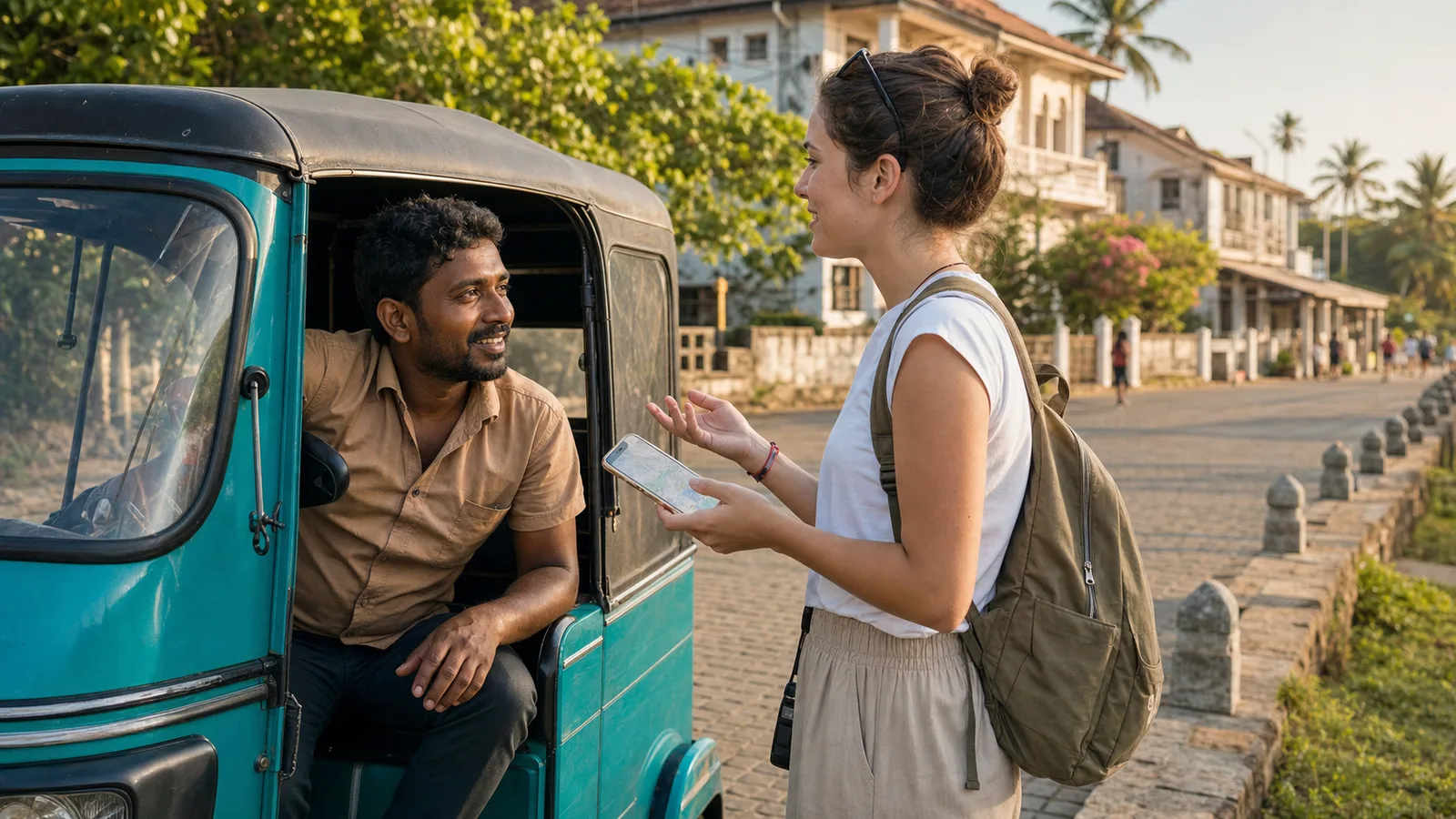
Tuk tuks are everywhere in Sri Lanka. They are cheap, fun, and sometimes confusing. Knowing a few phrases will save you money and frustration.
| English | Sinhala Phrase | Pronunciation |
|---|---|---|
| How much is it? | Keeyada? | kee-ya-da |
| Can you take me to this place? | Me thanata yanna puluwanda? | me tha-na-ta yan-na pu-lu-wan-da |
| Please stop here | Methanin nawaththanna | me-tha-nin na-wath-than-na |
| Go straight | Kelima yanna | ke-li-ma yan-na |
| Turn left | Wamata harawanna | wa-ma-ta ha-ra-wan-na |
| Turn right | Dakunata harawanna | da-ku-na-ta ha-ra-wan-na |
| I want to go to the hotel | Mata hotel ekata yanna ona | ma-ta hotel eka-ta yan-na oh-na |
Important travel tip for tuk tuks. Always agree on the price before you start the ride if there is no meter. Point to your phone map and say Me thanata yanna puluwanda? then ask Keeyada?
Keep your hotel name and address saved on your phone. Showing the address is sometimes easier than speaking.
Sinhala Phrases for Restaurants and Food
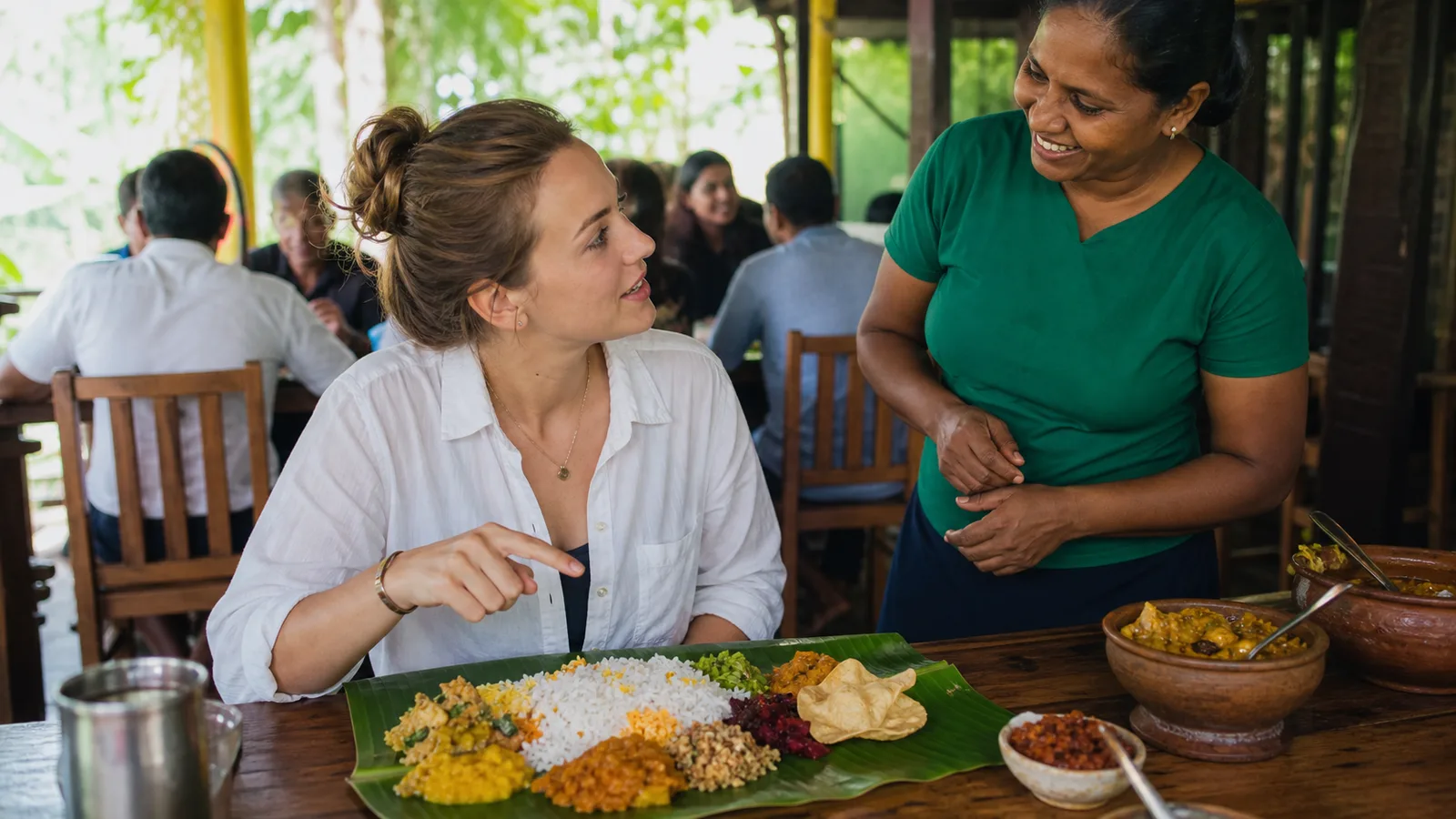
Sri Lankan food is delicious. But if you are not used to spices, you need to know how to ask for less heat. These phrases will help you order food and enjoy your meals without worry.
| English | Sinhala Phrase | Pronunciation |
|---|---|---|
| I am hungry | Mata badagini | ma-ta ba-da-gi-ni |
| I want rice and curry | Mata bath saha curry ona | ma-ta bath sa-ha curry oh-na |
| Not spicy, please | Miris aduwen denna | mi-ris a-du-wen den-na |
| Very tasty | Hari rasai | ha-ri ra-sai |
| Can I have the menu? | Menu eka denna puluwanda? | menu eka den-na pu-lu-wan-da |
| I am vegetarian | Mama vegetarian | ma-ma vegetarian |
| No meat | Mas epa | mas e-pa |
| Water, please | Wathura denna | wa-thu-ra den-na |
Food allergy warning. If you have serious allergies to nuts, seafood, or dairy, do not rely on pronunciation alone. Write down your allergy clearly or use our AI Travel Translator for Sri Lanka to show the exact phrase to restaurant staff.
The phrase Miris aduwen denna will be your best friend if you cannot handle spicy food. Say it with a smile and most places will adjust the heat for you.
Sinhala Phrases for Shopping and Markets
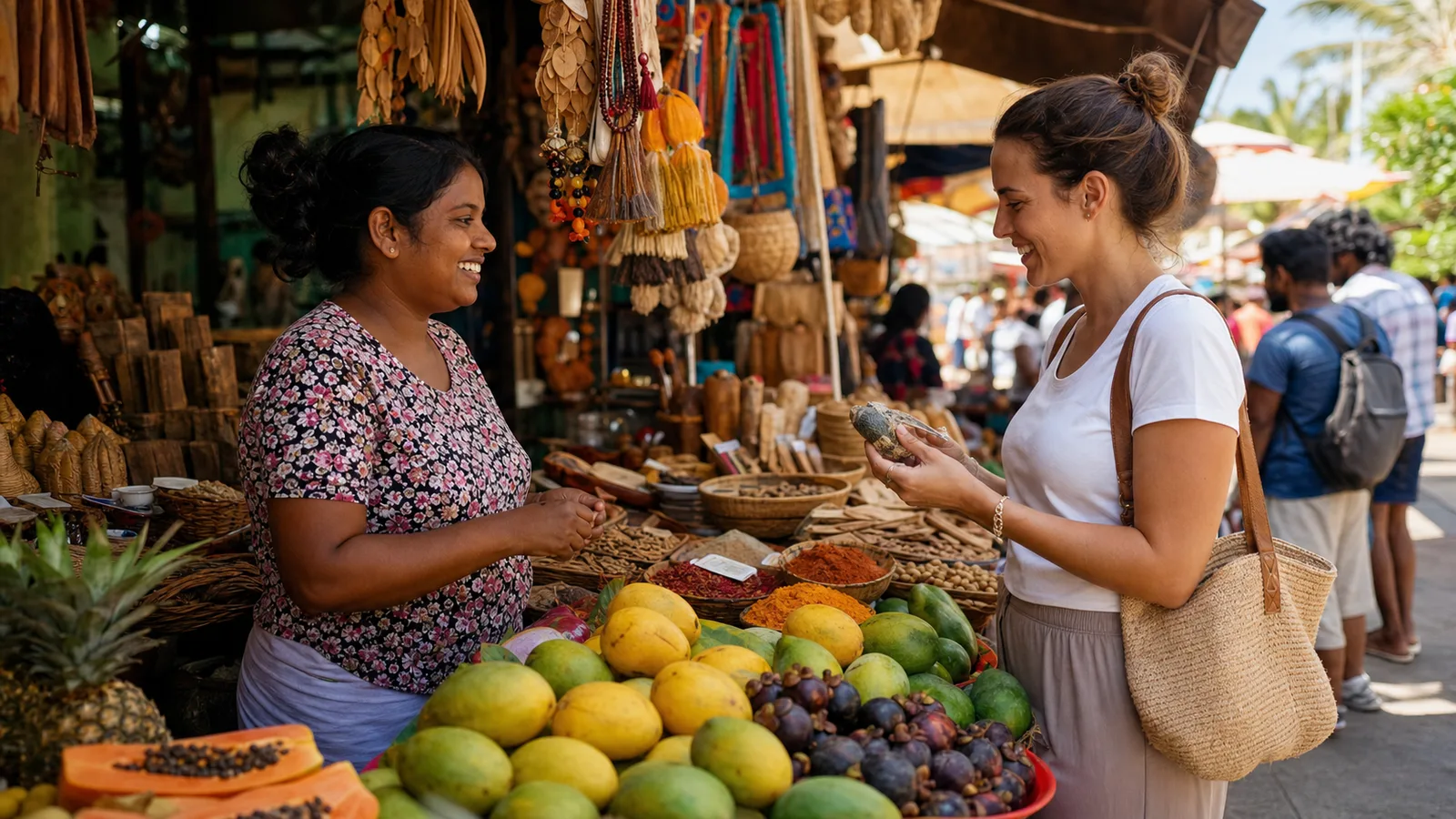
Local markets in Sri Lanka are colourful, lively, and full of good deals. But you need to ask the price and sometimes bargain. These phrases will help you shop with confidence.
| English | Sinhala Phrase | Pronunciation |
|---|---|---|
| How much is this? | Meka keeyada? | me-ka kee-ya-da |
| Can you reduce the price? | Gana adu karanna puluwanda? | ga-na a-du ka-ran-na pu-lu-wan-da |
| I want this | Mata meka ona | ma-ta me-ka oh-na |
| I do not want it | Mata meka epa | ma-ta me-ka e-pa |
| Too expensive | Gana wadi | ga-na wa-di |
| Do you have another colour? | Wena colour ekak thiyenawada? | we-na colour ekak thi-ye-na-wa-da |
Bargaining Etiquette
- Bargaining is common in local markets.
- Bargaining is not expected in supermarkets, pharmacies, brand stores, or fixed-price shops.
- Keep it friendly and respectful.
- If the price feels fair to you, accept it.
- A smile goes further than a lower price.
Start with Meka keeyada? Then if the price seems high, try Gana adu karanna puluwanda? Most vendors will come down a little.
Sinhala Phrases for Directions
Getting lost in a new country happens to everyone. These direction phrases will help you find your way back to your hotel, the bus stop, or that restaurant you loved.
| English | Sinhala Phrase | Pronunciation |
|---|---|---|
| Where is this place? | Me thana koheda? | me tha-na ko-he-da |
| Where is the toilet? | Toilet eka koheda? | toilet eka ko-he-da |
| Where is the bus stop? | Bus halt eka koheda? | bus halt eka ko-he-da |
| Is it near? | Langa da? | lan-ga da |
| Is it far? | Durada? | du-ra-da |
| I am lost | Mata para weraduna | ma-ta pa-ra we-ra-du-na |
Quick Direction Tips
- Keep your hotel name and address saved on your phone.
- Take a screenshot of the address.
- Save your hotel location on Google Maps.
- Show the address on your phone when pronunciation feels difficult.
The phrase Mata para weraduna means I am lost. Most locals will understand and try to help you.
Sinhala Phrases for Emergencies and Safety
Nobody wants to use these phrases. But knowing them before you need them can make a real difference. Keep this section saved on your phone.
| English | Sinhala Phrase | Pronunciation |
|---|---|---|
| Help me | Mata udaw karanna | ma-ta u-daw ka-ran-na |
| I need a doctor | Mata doctor kenek ona | ma-ta doctor ke-nek oh-na |
| Call the police | Policeyata call karanna | po-lee-si-ya-ta call ka-ran-na |
| I am sick | Mata leda | ma-ta le-da |
| Where is the hospital? | Hospital eka koheda? | hospital eka ko-he-da |
| I lost my passport | Mage passport eka nathi una | ma-ge passport eka na-thi u-na |
Important safety note. In a real emergency, contact local authorities, your hotel reception, your travel guide, or your embassy first. Use these phrases as a way to explain what you need, not as your only plan.
Save your hotel's phone number and local emergency contacts before you start your trip.
Sinhala Phrases for Making Friends with Locals
Sri Lankans are among the friendliest people you will meet. A small attempt to speak their language often turns into a conversation, a smile, or even an invitation for tea. These phrases help you connect.
| English | Sinhala Phrase | Pronunciation |
|---|---|---|
| What is your name? | Oyage nama mokakda? | o-yaa-ge na-ma mo-kak-da |
| My name is... | Mage nama... | ma-ge na-ma |
| Nice to meet you | Oyawa hambawenna sathutui | o-ya-wa ham-ba-wen-na sa-thu-tui |
| Sri Lanka is beautiful | Sri Lanka lassanai | sri lanka las-sa-nai |
| I like Sri Lanka | Mama Sri Lankawata kamathi | ma-ma sri lanka-wa-ta ka-ma-thi |
When a local asks your name, they are usually being genuinely friendly, not just polite. Feel free to ask them the same question back. You might end up learning about their family, their village, or their favourite local restaurant. That is one of the best parts of travelling in Sri Lanka.
Sinhala Numbers Tourists Should Know
You do not need to count to one thousand in Sinhala. But knowing numbers up to ten, plus hundred and thousand, will help you with prices, tuk tuks, and markets.
| Number | Sinhala | Pronunciation |
|---|---|---|
| 1 | Eka | e-ka |
| 2 | Deka | de-ka |
| 3 | Thuna | thu-na |
| 4 | Hathara | ha-tha-ra |
| 5 | Paha | pa-ha |
| 6 | Haya | ha-ya |
| 7 | Hatha | ha-tha |
| 8 | Ata | a-ta |
| 9 | Navaya | na-va-ya |
| 10 | Daha | da-ha |
| 100 | Seeya | see-ya |
| 1000 | Dahasa | da-ha-sa |
When someone tells you a price in Sinhala, listen for seeya for hundred or dahasa for thousand. If you miss the number, ask Keeyada? again or use your phone calculator to show the number.
Common Sinhala Travel Phrases by Situation
Sometimes you just need one phrase that works for the moment you are in. This table gives you the best phrase for common travel situations in Sri Lanka.
| Situation | Best Sinhala Phrase | What It Means |
|---|---|---|
| Greeting someone | Ayubowan | Hello |
| Thanking someone | Bohoma istuti | Thank you very much |
| Taking a tuk tuk | Me thanata yanna puluwanda? | Can you take me to this place? |
| Ordering food | Miris aduwen denna | Less spicy, please |
| Shopping | Meka keeyada? | How much is this? |
| Asking directions | Me thana koheda? | Where is this place? |
| Emergency | Mata udaw karanna | Help me |
Keep this table saved on your phone. When you forget the longer phrases, these seven will cover most of your daily needs in Sri Lanka. Start with Ayubowan and end with Bohoma istuti. That alone will make locals remember you as a respectful traveller.
Sinhala vs Tamil: Which Language Should Tourists Use in Sri Lanka?
Sri Lanka has two official languages, Sinhala and Tamil, both formally recognised under the constitution and administered by the Department of Official Languages. Tourists often wonder which one to learn or use.
| Region or Situation | Best Language to Try | Notes |
|---|---|---|
| South, West, Central and many inland areas | Sinhala | Useful in Colombo, Kandy, Ella, Galle, Mirissa, Bentota, and many common tourist routes |
| North and East | Tamil | Useful in Jaffna, Trincomalee, Batticaloa, and Tamil-speaking communities |
| Hotels, restaurants, and tourist sites | English | Commonly understood in most tourist-facing places |
For most tourist routes, learning a few basic Sinhala phrases is very helpful. If your trip includes the North or East, learning a few Tamil phrases is also useful. You can also use English as your main language and add a local phrase when you want to be polite.
If you are travelling between Trincomalee, Pasikudah, and Arugam Bay during the summer dry season, our complete East Coast travel guide walks through the eastern regions where Tamil starts to take over from Sinhala in everyday use.
If you are not sure which language to use in a specific situation, a quick translator check on your phone will help you pick the right phrase before you speak.
How an AI Travel Translator Can Help in Sri Lanka
This guide gives you the most useful Sinhala phrases. But what if you need to say something longer or more specific? That is where an AI travel translator becomes useful.
| What It Does | How It Helps You |
|---|---|
| Translate English to Sinhala | Create any phrase you need instantly |
| Translate English to Tamil | Useful for North and East Sri Lanka |
| Save common phrases | Keep your important phrases ready before your trip |
| Show written translation | Show the screen to drivers, shop owners, or staff |
Use it for taxis, restaurants, hotels, shopping, directions, or emergencies. When pronunciation feels too hard, just show the translated text on your phone.
Before your trip, try our free AI Travel Translator for Sri Lanka and save common phrases for taxis, hotels, food, shopping, and directions.
Tips for Using Sinhala Phrases Respectfully
Learning a few phrases is good. Using them the right way is even better. These tips will help you avoid accidental rudeness and show genuine respect for Sri Lankan culture.
- Smile and speak slowly. A friendly face makes any language easier to understand.
- Use polite words often. Please and thank you go a long way in Sri Lanka.
- Do not laugh at pronunciation. Your attempt is already better than no attempt.
- Do not expect everyone to speak English. Many do, especially in tourist areas, but patience is appreciated.
- Show written text when speaking feels hard. Your phone screen works as a translator.
- Respect local customs. Remove shoes before entering temples, dress modestly in sacred places, and greet elders first.
- Be patient with yourself. You are learning. That is enough.
The fact that you are reading this guide already puts you ahead of most tourists. Now go and try. Locals will appreciate you for it.
Final Thoughts
Learning a few Sinhala phrases will not make you fluent. But that is not the goal.
The goal is to show respect, connect with locals, and make your trip to Sri Lanka smoother and more memorable. A simple Ayubowan at the start of a conversation and Istuti at the end changes how people treat you.
You do not need to speak perfectly. You just need to try.
Keep this guide saved on your phone. Practice a few phrases before you arrive. Lean on a translator for anything longer or anything you cannot quite remember on the day.
Sri Lanka is waiting for you. Pack your bags, learn a few words, and come experience this beautiful island.
FAQs
What are the most useful Sinhala phrases for tourists?
The most useful phrases are Ayubowan for hello, Istuti for thank you, Keeyada? for how much, Wathura denna for water please, Mata udaw karanna for help me, Me thana koheda? for where is this place, and Miris aduwen denna for less spicy please. These seven phrases cover greetings, shopping, emergencies, directions, and food.
Do people speak English in Sri Lanka?
Many people in hotels, tourist areas, restaurants, and city areas speak some English. However, Sinhala phrases are very useful in local markets, tuk tuks, small towns, and rural areas. English works well in Colombo, Kandy, Galle, and most tourist spots.
Is Sinhala hard for tourists to learn?
Sinhala may feel new to English speakers at first. But tourists only need a few simple phrases for travel. You do not need grammar or fluency. Locals appreciate the effort even if your pronunciation is not perfect. Start with hello, thank you, and how much.
What does Ayubowan mean?
Ayubowan is a respectful Sinhala greeting. People use it to say hello. The word carries a deeper meaning of wishing someone a long and prosperous life. It is appropriate at any time of day.
What Sinhala phrase means thank you?
Istuti means thank you. For extra thanks, say Bohoma istuti, which means thank you very much. Use it after meals, tuk tuk rides, or anytime someone helps you.
What Sinhala phrase should I use in a tuk tuk?
Say Me thanata yanna puluwanda?, which means can you take me to this place. Then ask Keeyada? to ask how much. Always agree on the price before the ride starts if there is no meter.
Should I learn Sinhala or Tamil before visiting Sri Lanka?
Sinhala is very useful in the South, West, and Central tourist areas including Colombo, Kandy, Ella, Galle, and Mirissa. Tamil is useful in the North and East including Jaffna and Trincomalee. English works well in most tourist places. Learn a few phrases in the language of the region you are visiting.
Can I use an AI translator in Sri Lanka?
Yes. An AI travel translator can help you translate English into Sinhala or Tamil for taxis, hotels, restaurants, shopping, directions, and simple travel situations. It is especially helpful when you need a longer sentence or when pronunciation feels difficult.
Related Articles
Sri Lanka Visa and ETA: Everything You Need Before You Fly
Sri Lanka made its tourist visa free for 40 countries in May 2026. Here is who qualifies, what it still costs everyone else, and how to apply without getting stung by a fake visa site.
Read MoreSri Lanka Visa for Indian Citizens: Free ETA, Rules and How to Apply
Indian passport holders now get a free 30-day Sri Lanka ETA with double entry. Here is what changed in May 2026, what documents you need, and why you should not pay an agent for it.
Read MoreBest Time to Visit Sri Lanka: A Month-by-Month Guide by Region
The best time to visit Sri Lanka depends on which coast you want: December to April for the south, west and hill country, May to September for the east. Weather, crowds and the best region for every month, with official climate and arrivals data.
Read MoreWritten by
Ashan LokugeTravel writer
Ashan Lokuge is a content writer, SEO specialist and software engineer at Wonder of Ceylon. He travels all nine provinces of Sri Lanka to research every guide in person, focusing on the places most travel guides miss.
View all posts by Ashan