Elephants In Sri Lanka: Where To See Them, The Tuskers And The Gathering
Where to see wild elephants in Sri Lanka park by park, when the Minneriya gathering happens, why tuskers are so rare, the famous tuskers past and present, and how to see elephants without harming them.
Written by Ashan Lokuge
Last updated on Published on

Few countries in Asia make it this easy to watch wild elephants. Choose the right park in the right month and one afternoon in a jeep can bring dozens into view, from newborn calves to ageing bulls. Some of those bulls are tuskers. These long-tusked males are regarded as national treasures here, and today they are rarer than leopards.
Quick answer: the best places to see wild elephants in Sri Lanka are Minneriya and Kaudulla national parks near Habarana (the famous "gathering" peaks in August and September), Udawalawe National Park in the south (reliable all year), and Yala, Wilpattu and Gal Oya. Tuskers are rare: only about 7% of Sri Lankan males grow tusks, and conservationists think about 100 are left in the wild. Your best chance of a tusker is in the dry zone parks of the north and southeast, at Kala Wewa, Udawalawe, Yala and Minneriya.
Park by park, this guide explains where and when to see elephants, what a tusker actually is and how many remain, the famous tuskers past and present, the Kandy Esala Perahera, and how to see elephants without paying for their suffering. Colombo sits three to five hours from most of the best elephant parks, and small roads connect them. That makes a private driver in Sri Lanka the simplest way to reach them and to time a safari for the late afternoon, when the herds come out to the water.
Elephants In Sri Lanka At A Glance
| Fact | Detail |
|---|---|
| Species | Sri Lankan elephant (Elephas maximus maximus), the largest of the three Asian elephant subspecies |
| Status | Endangered (Asian elephant, IUCN Red List) |
| Wild population | At least 7,451 in 2024 (Ministry of Environment); 5,879 in 2011 |
| Tuskers | About 7.5% of males (1999 study); about 100 thought to be alive in the wild |
| Best park for numbers | Minneriya and Kaudulla, July to October |
| Most reliable all year | Udawalawe |
| Best chance of a tusker | Kala Wewa and Galgamuwa, Udawalawe, Yala, Minneriya |
| Cultural highlight | Kandy Esala Perahera, July or August |
The Asian elephant carries an Endangered listing on the IUCN Red List of Threatened Species. Habitat loss and fragmentation drive most of that risk. Within Sri Lanka, the picture runs the other way: numbers here are going up, not down. According to figures the Ministry of Environment has released, the minimum wild elephant population stands at 7,451 in 2024. The 2011 national count recorded 5,879, so this is a rise. Officials are careful to call it a minimum estimate rather than an exact headcount. Some conservation groups, meanwhile, have asked how the 2024 count was carried out.
Where To See Wild Elephants In Sri Lanka
Nearly every wild elephant in Sri Lanka lives in the dry zone: the drier north, east and southeast. Very few live in the hill country or the wet southwest. So a good elephant park is only a few hours from the south coast beaches and the tea country around Ella. Kandy, Nuwara Eliya and Colombo, though, have no wild elephants at all.
The Department of Wildlife Conservation runs every park listed below. It also fixes the entry fees, opening hours and closures. Safaris go out in open jeeps with a driver who knows the park. Most trips run in the morning or late afternoon. Go late in the day if you can. Herds leave the forest then to drink and bathe, which usually means better sightings.
| Park | Area | Elephants | Best months | Nearest base |
|---|---|---|---|---|
| Minneriya | North central | Very large herds, the gathering | July to October | Habarana, Sigiriya |
| Kaudulla | North central | Large herds, gathering moves here later | August to December | Habarana |
| Udawalawe | South | Herds almost every drive, Elephant Transit Home | All year | Udawalawe, Embilipitiya |
| Yala | Southeast | Good numbers, tuskers seen | February to August | Tissamaharama |
| Wilpattu | Northwest | Fewer but wilder, tuskers seen | February to October | Anuradhapura, Puttalam |
| Kala Wewa and Galgamuwa | North central | Small herds, the island's best tusker country | June to October | Anuradhapura, Dambulla |
| Gal Oya | East | Elephants swimming between islands | March to July | Inginiyagala, Ampara |
Minneriya, Kaudulla And Hurulu Eco Park
Habarana sits in the middle of the Cultural Triangle, and all three parks are within half an hour of it. That's why most travellers slot them between Sigiriya, Dambulla and Polonnaruwa. Water and fresh grass keep the herds on the move between the parks all year. Every morning the Habarana jeep drivers swap information and choose the park holding the elephants that week. Ask your driver for the best park on the day rather than a fixed one.
The gathering is what made Minneriya the best known of the three, and the next section covers it. Come about September and Kaudulla takes over. By then Minneriya's grass has been grazed down and the Kaudulla tank is starting to shrink. Mahasen, the great cross-tusker, has been spotted at Minneriya, usually around April. The high-risk tusker Sumedha lives in the area. Hurulu Eco Park is a forest reserve, not a national park, and from about November to March, the wetter months, it is often the best choice.
Udawalawe National Park
Udawalawe is your safest bet for elephants in one drive. A big reservoir sits at the centre, ringed by open grassland and scrub, so herds are simple to find at any time of year. Calves are common. The Elephant Transit Home is based here as well, rearing orphaned calves and releasing them back into the wild (see the ethics section below). Bullet, the park's best-known tusker, was raised there as an orphan.
As a stop between the hill country and the south coast, Udawalawe works well. Ella is about two hours away, and so are the beaches around Tangalle and Mirissa.
Yala National Park
Yala made its name with leopards. Its elephant numbers are healthy too, though, and some of the island's best-known wild tuskers live there. Being the busiest park in the country, it draws queues of jeeps whenever a leopard is spotted. For several weeks between September and October, the main block has often closed in recent years, so check before planning a trip for those months. Nandimithra and Sando are among Yala's named tuskers. In the past Gemunu, Thilak and the cross-tuskers Maha Poottuwa and Podi Poottuwa lived here as well (all profiled in our tusker guide).
Wilpattu National Park
Sri Lanka's largest national park, Wilpattu is a vast forest dotted with natural lakes called villus. Compared with Minneriya or Udawalawe, you'll see fewer elephants. You'll also see far fewer jeeps, and the elephants you do meet are often lone bulls, tuskers among them. Travellers who want a quieter, wilder safari and don't mind a longer drive inside the park are the right fit.
Kala Wewa And Galgamuwa
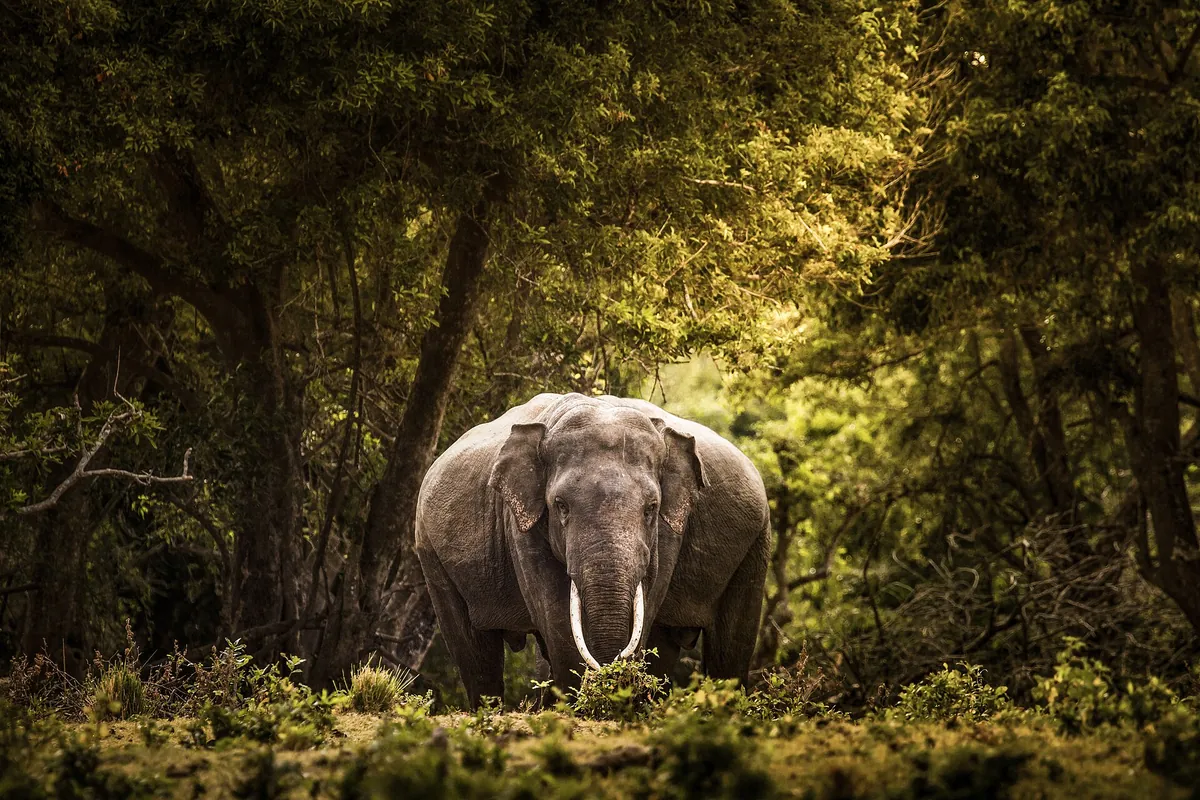
Tusker country in Sri Lanka means the forests around the Kala Wewa reservoir and the Galgamuwa area, between Dambulla and Anuradhapura. Kavantissa, the tallest wild tusker of recent years, lived here until his death in October 2026. Bathiya, Revatha and Barana lived here too, and today it is home to Mangala, Vijaya and several of the tuskers on the government's high-risk list. Tourism here is small scale. Go with a local tracker, or ask your driver to arrange one, and keep your expectations open: a sighting is a privilege, not a guarantee.
Gal Oya National Park
In the east, Gal Oya is the park for watching elephants from a boat. Herds swim between the small islands of the Senanayake Samudraya reservoir, using their trunks as snorkels. The usual tourist route leaves it far behind, and that is part of its appeal.
The Elephant Gathering At Minneriya
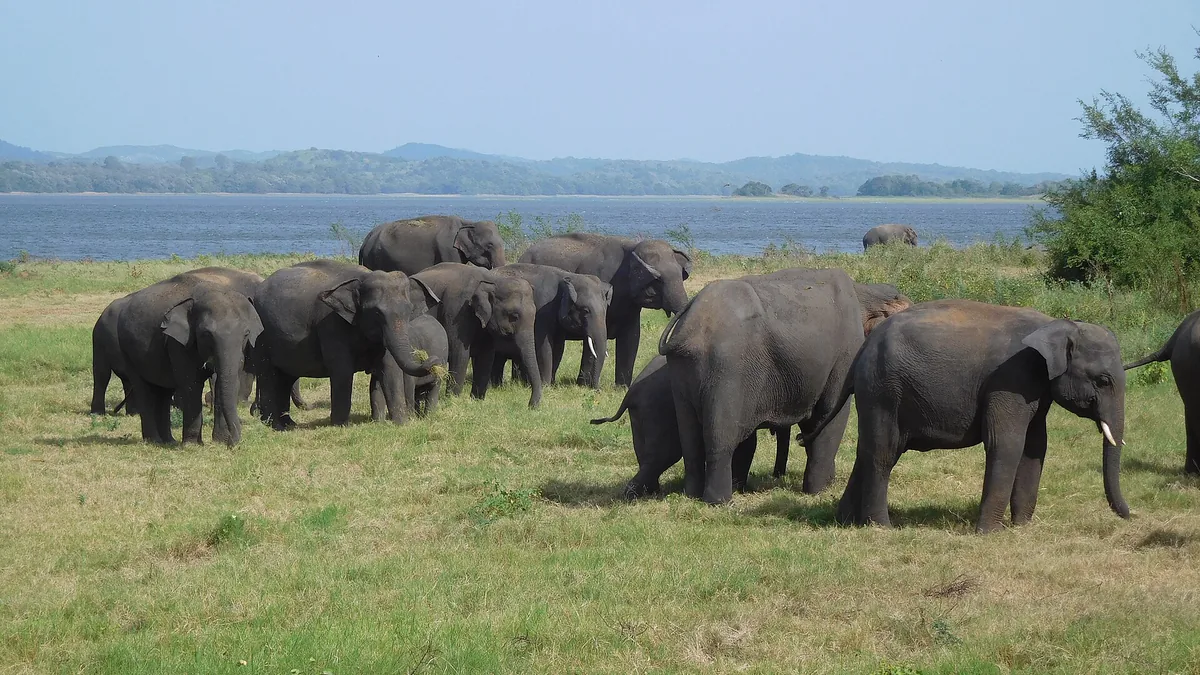
The dry season drains the Minneriya reservoir a little more each year, and what it leaves behind is a broad plain of fresh grass on the old lake bed. From the forests all around, elephants arrive to graze and drink. The herds then merge into a single enormous assembly. Locals call it "the gathering".
July is when it starts to build. August and September are the peak, and by October it tails off as the northeast monsoon brings rain and the herds scatter. Come in a good year and one afternoon can show you 300 to 400 elephants on the plain at once. Young bulls spar. Calves play in the shallows. Matriarchs keep watch. That kind of number is why people so often call the gathering the largest of Asian elephants anywhere.
Nothing here is guaranteed, though. Water level in the tank decides how the gathering goes, and irrigation authorities control that level, so nature is not the only factor. Local reports said only about 20 elephants were counted in September of 2021, a year when the reservoir was kept full. A few years earlier the count was more than 400. Before you plan your whole route around it, ask your driver or hotel what the current numbers are.
How to see it: stay in Habarana or Sigiriya, book an afternoon jeep safari of about three hours, and leave the choice between Minneriya and Kaudulla to the jeep driver on the day. If a wider trip is taking shape around the gathering, our Sri Lanka itinerary routes show how to combine the Cultural Triangle with the hill country and the coast in 7, 10 and 14 days.
When Is The Best Time To See Elephants In Sri Lanka?
You can see wild elephants in Sri Lanka in every month of the year. The trick is knowing where to look. For each part of the year, the table below names the best park. Planning beaches and hill country stops around the weather as well? Our guide to the best time to visit Sri Lanka by region sets out how the two monsoons divide the island.
| Months | Best places for elephants | Why |
|---|---|---|
| January to March | Udawalawe, Yala, Wilpattu, Hurulu Eco Park | Dry season in the south and northwest, good weather for safaris |
| April to June | Udawalawe, Yala, Wilpattu, Gal Oya | Herds concentrate near water as the dry season deepens |
| July to September | Minneriya, Kaudulla, Kala Wewa, Udawalawe | The gathering at its peak, best tusker months in the north |
| October to December | Kaudulla, Udawalawe, Hurulu Eco Park | Gathering ends, herds disperse, rain returns to the north and east |
What Is A Tusker?
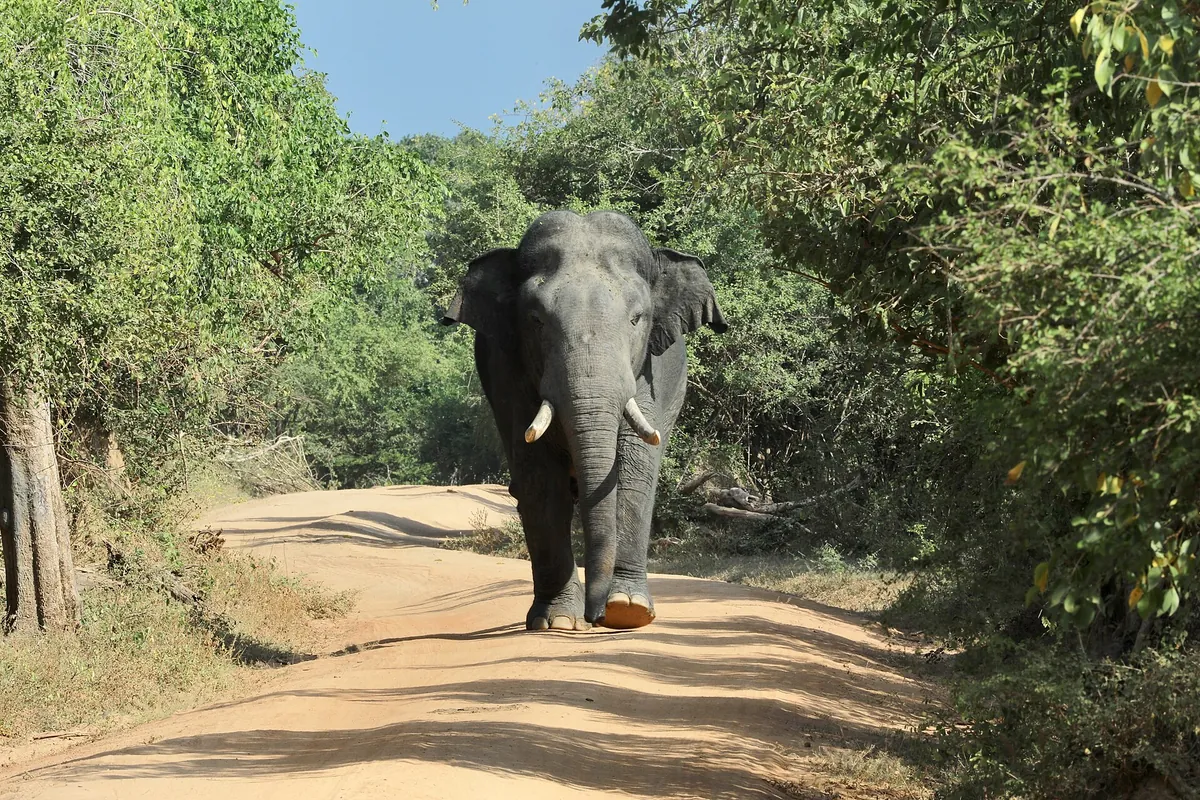
A tusker is a male elephant with long, visible tusks. In Sri Lanka the word matters. Tuskers are revered, they lead temple processions, and when a famous one dies the national news reports it.
Those tusks are elongated upper incisor teeth, and they go on growing for the whole of an elephant's life. Most elephants in Sri Lanka don't have them. Males usually grow nothing more than tushes, short tusks that hardly clear the upper lip. Females have tiny tushes or none. Compare African elephants, where males and females both normally carry tusks.
A 1999 study cited by Mongabay found that only about 7.5% of Sri Lankan male elephants had tusks. That makes the island's elephants among the least tusked anywhere in Asia. History, scientists believe, is part of the explanation. Tuskers were the elephants most in demand for capture over the centuries, whether for kings, temples or trade. Heavy hunting under British rule removed many more. Kill off the big-tusked males generation after generation and fewer survive to pass the trait on.
Elephant Vs Tusker: What Is The Difference?
Tuskers are elephants, but only a small minority of Sri Lankan elephants are tuskers. "Tusker" is neither a species nor a subspecies. It describes a male Sri Lankan elephant that happens to grow long tusks, and on this island that one feature changes how people see him. Sinhala has separate words for the two cases: an ætha is a tusker, while a male without tusks usually goes by aliya, the everyday word for an elephant.
| Tusker (ætha) | Tuskless male (aliya) | Female | |
|---|---|---|---|
| Tusks | Long tusks, clearly visible | Short tushes inside the lip, or none | Tiny tushes or none |
| Share of elephants | About 7.5% of males | Over 90% of males | Most of the elephants in a herd |
| Size | Adult bulls up to about 3 metres or more at the shoulder | Same range; tusks do not make a bull bigger | Smaller than adult males |
| How they live | Adult bulls live alone or in loose bachelor groups | Same as tuskers | In family herds led by an older female |
| In culture | Revered, chosen to carry the Tooth Relic casket | Take part in processions, not chosen to carry the casket | Take part in processions |
| Biggest threat | Ivory poaching plus conflict with farmers | Conflict with farmers | Conflict with farmers, trains, electric fences |
For a traveller, the practical upshot is this. A good safari will show you dozens of elephants, mostly females, calves and tuskless males, and you may never see a tusker. Make Kala Wewa, Minneriya, Udawalawe or Yala your plan if spotting one is the goal, and book more than a single drive.
Tusker Vs Elephant Fights: Who Wins?
Bulls fight over females as adults, above all in musth. This yearly state brings raised testosterone, aggression and a dark fluid from the glands between the eye and the ear. The tusker winning every time might be what you'd expect. Research on Asian elephants says otherwise. Down To Earth's report on tusker and tuskless bull contests sets it out: a musth bull usually dominates a bull that is not in musth, and if both are in musth the bigger animal tends to win. Tusks matter relatively little.
One bull backing off ends most of these fights. Some are fatal. Thilak, Yala's oldest tusker, died after a fight in 2017. Chandi of Galgamuwa died after a fight with another tusker in 2024. Gemunu lost both his tusks in fights with Sando, Parakum and Nandimithra. The videos below show what these contests look like.
How Many Tuskers Are Left In Sri Lanka?
Estimates vary, and none of them is large. The 2011 national elephant count logged 122 tuskers. A group of wildlife photographers called Wild Tuskers Srilanka tracks individual tuskers, and over the last decade it has identified around 300. The group believes roughly 100 remain in the wild, according to Mongabay's November 2026 report on Sri Lanka's high-risk tuskers. That report also placed 17 of them on a high-risk list. Since then the government has brought in the army, navy and air force to help protect them.
Famous Tuskers Of Sri Lanka
Trackers and photographers who follow Sri Lanka's wild tuskers give nearly every one a name. Many carry a story the whole country knows. Here are a few of the best known:
| Tusker | Where | Status |
|---|---|---|
| Agbo | Anuradhapura District | Alive, top of the 2026 high-risk list |
| Mahasen | Minneriya and Kaudulla | Believed alive, not seen for months |
| Nandimithra | Yala National Park | Alive |
| Mangala | Kala Wewa and Galgamuwa | Alive |
| Kavantissa | Galgamuwa | Died October 2026, the tallest of them all |
| Nadungamuwa Raja | Temple tusker, Kandy Esala Perahera | Died 2022, now preserved in Colombo |
More than 40 of them, living and lost, are profiled in our guide to the famous tuskers in Sri Lanka. For each you get where he lives, the parks he visits and his story, plus video of most.
Human-Elephant Conflict In Sri Lanka
A decade ago Sri Lanka had fewer elephants. It now has more, and it also carries one of the worst elephant-human conflicts on earth. Elephants use land that mostly falls outside national parks, and farms and villages share it. Forests give way to farming, roads and new settlements. Old routes vanish, so the elephants turn to paddy fields, banana plots, sugar cane and home gardens, largely after dark. Firecrackers and electric fences are how farmers defend their harvests. Some go further, illegally, using guns, poison and hakka patas, small explosives hidden in fruit or vegetables.
Deaths By Year
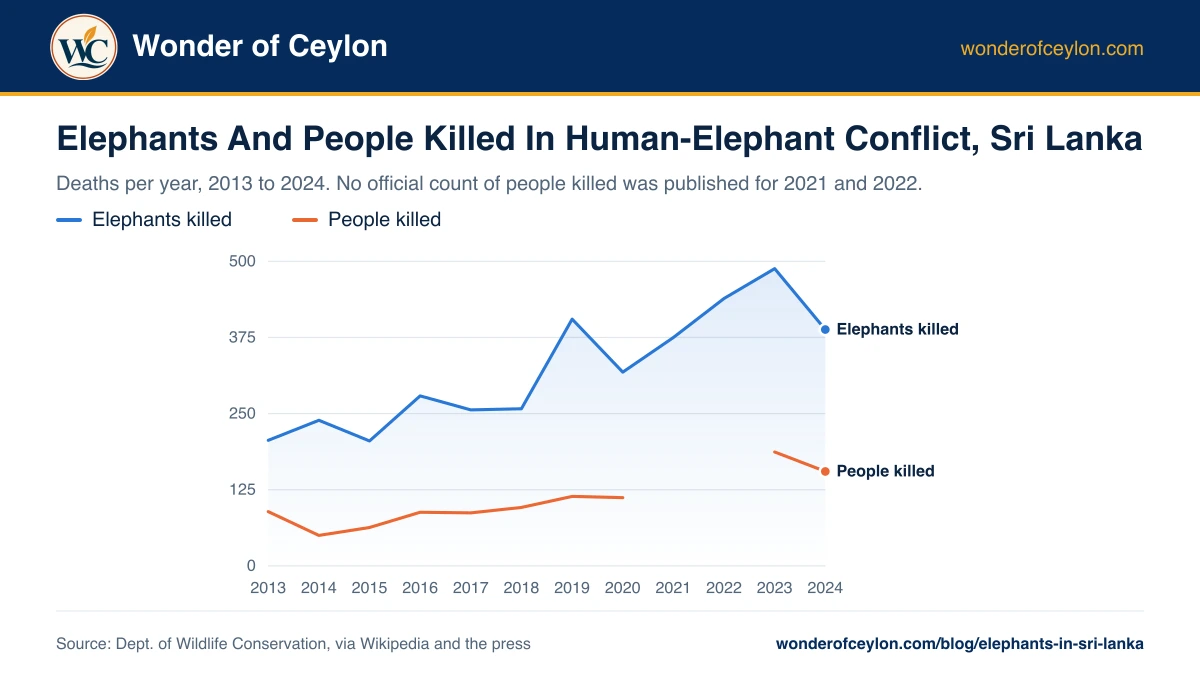
Neither side wins. Elephant deaths more than doubled between 2013 and 2023, and in 2023 the Department of Wildlife Conservation recorded a record 488 elephants and 187 people killed. Each human death is a farmer guarding a field, a cyclist on a dark road or a villager walking home after sunset.
Elephants And People Killed In Human-Elephant Conflict, Sri Lanka
Deaths per year, 2013 to 2024. No official count of people killed was published for 2021 and 2022.
 Download or share this chart
| Year | Elephants killed | People killed by elephants |
|---|---|---|
| 2013 | 206 | 89 |
| 2014 | 239 | 50 |
| 2015 | 205 | 63 |
| 2016 | 279 | 88 |
| 2017 | 256 | 87 |
| 2018 | 258 | 96 |
| 2019 | 405 | 114 |
| 2020 | 318 | 112 |
| 2021 | 375 | Not published |
| 2022 | 439 | Not published |
| 2023 | 488 | 187 |
| 2024 | 388 | 155 |
| 2025 | 397 (to mid-December) | 113 (January to September) |
| 2026 | 180 (to 12 August) | Not yet published |
These are the Department of Wildlife Conservation's figures as reported in the press, and reports for the same year can differ. Take 2025: Mongabay reported 455 elephant deaths, while the department had 397 by mid-December.
How Elephants Die
How much of the toll people cause is clear from the department's breakdown for 2025. Of the 397 elephant deaths recorded in 2025, guns accounted for 71, electrocution for 56, trains for 46, hakka patas for 20, abandoned wells for 8, drowning for 4 and poison for 2. Losses were heaviest in the Eastern wildlife region (82 deaths), then Anuradhapura (77) and Polonnaruwa (69). Most travellers on safari go to that same dry zone.
Why Tuskers Face Extra Risk
Tuskers add another layer of risk. Big bulls roam further, raid crops with more confidence and live nearer to people. Their ivory keeps them a target, even though killing an elephant is illegal in Sri Lanka. Almost every famous wild tusker that has died in recent years without a fight was shot or electrocuted.
What Is Being Done
Fence people in, not elephants out. Conservationists such as Dr Prithiviraj Fernando have made that argument for many years. In practice it means electric fences around villages and fields, kept up by the communities themselves, rather than long fences along park boundaries that elephants learn to break. Villages around Galgamuwa, for example, have built community fences of this kind and maintain them today.
Other measures include the Hasthi Sena military operation to protect high-risk tuskers, compensation for farmers who lose crops or homes, and keeping elephant corridors between parks free of new building. Progress is uneven. Development projects in Hambantota have held up a managed elephant reserve planned in the south in 2009 for years.
What It Means For Travellers
Visitors are rarely caught up in human-elephant conflict directly, yet it explains much of what you will see. Electric fences line the roads of the dry zone. Tree houses stand in paddy fields where farmers keep watch at night. Elephants wait beside roads for food. Simple things help most. Never feed wild elephants. Drive slowly at dusk. Follow the safety advice below. Put your money into safaris, local guides and village homestays, and rural communities gain a reason to want elephants alive.
Elephants And The Kandy Esala Perahera
Night after night in Kandy, processions honour the Sacred Tooth Relic kept at the Temple of the Tooth. This is the Kandy Esala Perahera, Sri Lanka's biggest Buddhist festival, and it runs for roughly ten nights in July or August. The lunar calendar places it around the Esala full moon. In 2026 the dates were 18 to 28 August.
Dozens of elephants walk in the procession, wearing embroidered costumes covered in lights, alongside drummers, dancers and fire twirlers. At the centre of it all is the casket tusker, carrying a golden casket linked to the relic. For an elephant's owner this is a huge honour. The role always goes to a large, calm tusker, which is how names like Nadungamuwa Raja and Indi Raja became known across the country.
A real debate hangs over the Perahera as well. Animal welfare groups point to elephants walking for hours through crowds, noise, heat and fireworks, and to the way some captive elephants are kept and trained. Defenders point to centuries of tradition and the care the most famous tuskers receive. If you go, watch from a reserved seat rather than pressing into the crowd, and never use flash close to the elephants.
How To See Elephants In Sri Lanka Ethically
One rule covers everything: watch elephants in the wild, from a jeep or a boat, at a distance they choose. Wild elephants in their own habitat make the best experience in Sri Lanka, and it costs them nothing.
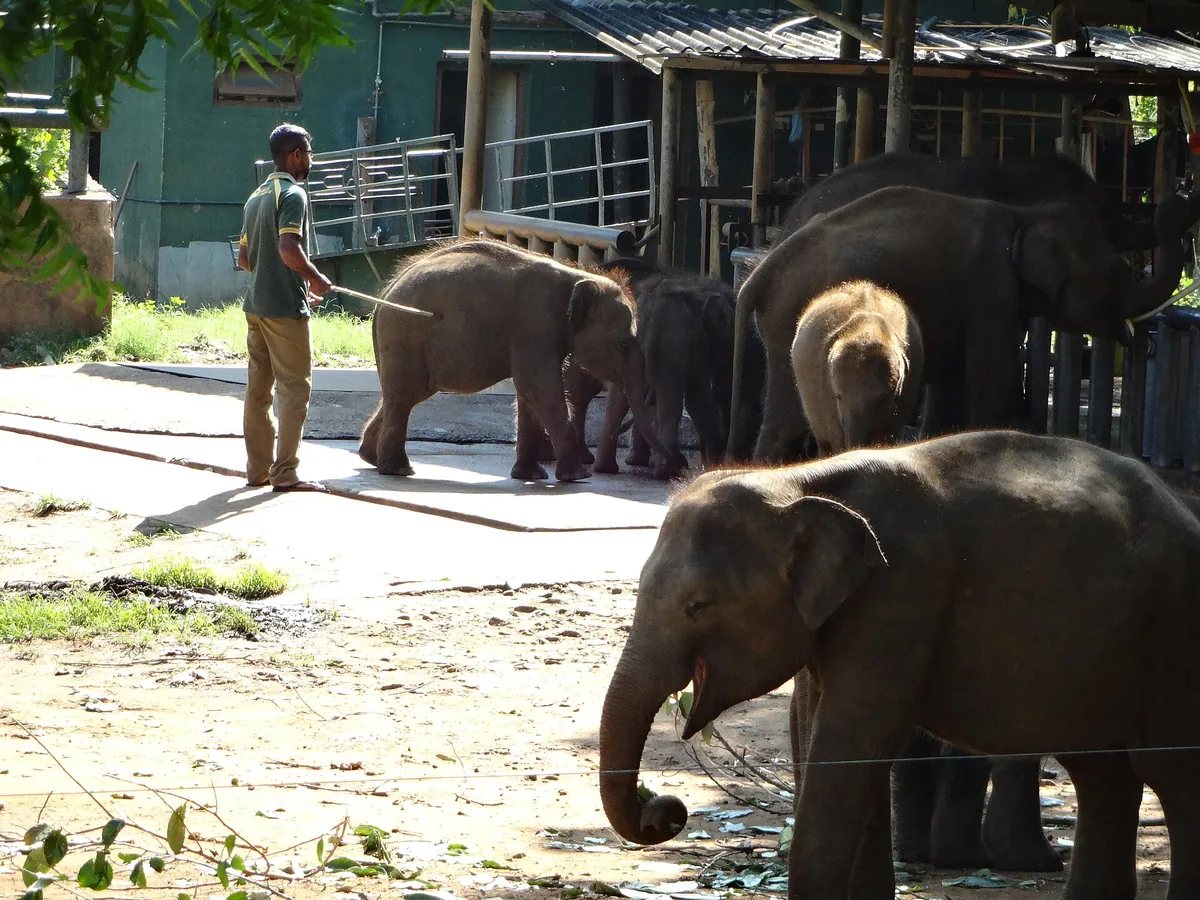
Udawalawe Elephant Transit Home (recommended). The Department of Wildlife Conservation established it in 1995 on the edge of Udawalawe National Park. Orphaned and injured calves are raised here, then returned to the wild once old enough. No visitor gets to touch the calves. A viewing platform lets you watch them come in for their milk feed several times a day, and the feeding times are posted at the gate. Pair it with a safari in the park next door.
Pinnawala Elephant Orphanage (think before you go). Of all the elephant attractions in the country, Pinnawala draws the most visitors. It sits near Kegalle on the road between Colombo and Kandy. When it opened in 1975 it was an orphanage. Today it is a captive breeding herd: many of its elephants were born there, and none go back to the wild. A 2010 Born Free Foundation report raised questions about animal welfare, travellers have described elephants chained for long periods, and several British tour operators stopped selling visits. Want elephants up close on the Colombo to Kandy road? Keep driving and see them in the wild later in your trip instead.
Elephant rides (avoid). Welfare groups consider the training methods behind elephant rides cruel, and ride elephants spend their lives in chains between shifts. We do not arrange elephant rides.
Places that let you bathe or feed elephants. Anything marketed as a "sanctuary" where you can touch, feed, bathe or take selfies with elephants deserves scepticism. Real sanctuaries keep people at a distance.
Safety Around Wild Elephants
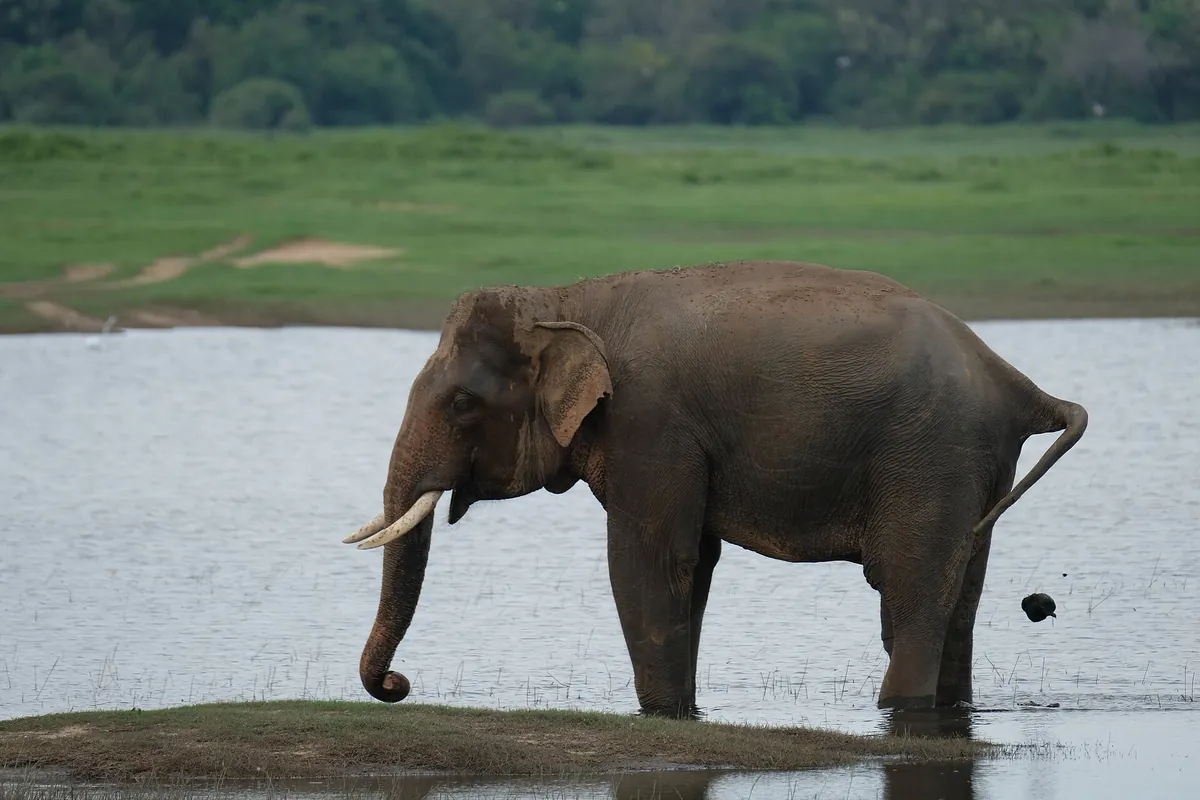
Visitors who keep to a few simple rules face little danger from wild elephants. People do die in Sri Lanka every year, though. The victims are nearly always villagers on foot after dark.
- Sit still in the jeep, keep quiet and leave the distance to your driver. A bull that spreads his ears, lifts his head and swings his trunk is telling you to go away. Back off.
- Dry zone elephants cross main roads, above all at dusk, along routes such as Habarana to Trincomalee and the Udawalawe reservoir road. Go slowly, stop well back and wait, and never drive between a mother and her calf.
- Never feed wild elephants. Beside the Udawalawe road, some elephants have learned to beg from passing cars, and feeding teaches them to approach vehicles. The elephant pays the price.
- Don't walk in elephant country after dark. Staying at a lodge near a park? Let the lodge's transport take you after sunset.
- National parks do not allow drones without a permit.
With a car and driver who knows the roads and the park gates, combining two or three parks is safest and easiest. Before you book, our Sri Lanka trip cost calculator gives you a realistic total for transport, hotels and safaris over the length of your trip.
FAQs About Elephants In Sri Lanka
Where Is The Best Place To See Elephants In Sri Lanka?
Minneriya and Kaudulla national parks near Habarana have the biggest herds, from July to October. Udawalawe National Park in the south gives the most dependable sightings in any month. Want a quieter safari with a chance of a lone tusker? Head for Wilpattu or the Kala Wewa area.
When Is The Elephant Gathering At Minneriya?
From July the gathering builds, and in August and September it peaks, as the shrinking Minneriya reservoir lays bare fresh grass on the lake bed. The northeast monsoon brings it to a close in October. Water level varies year to year, so check locally before you plan around it.
What Is The Difference Between An Elephant And A Tusker?
A tusker is a male elephant whose long tusks are clearly visible. Tuskers are all elephants, but only about 7.5% of Sri Lankan males grow tusks. Short tushes, or none at all, are what the rest have, and females almost never grow tusks. Sinhala uses ætha for a tusker and aliya for a tuskless elephant.
Does A Tusker Always Win A Fight Against A Tuskless Elephant?
No. Musth and body size decide most fights between bulls, according to research on Asian elephants, and tusks matter relatively little. A bigger tuskless bull in musth can beat a tusker.
How Many Elephants Are There In Sri Lanka?
At least 7,451 wild elephants, based on 2024 figures the Ministry of Environment released. That is up from 5,879 in 2011. Officials call the figure a minimum estimate.
Do Female Elephants Have Tusks In Sri Lanka?
Almost never. Female Asian elephants have either small tushes that barely show past the lip or no tusks at all. Most Sri Lankan males carry only tushes as well. African elephants work differently: both sexes usually have tusks.
Who Is The Most Famous Elephant In Sri Lanka?
From 2005 to 2021, Nadungamuwa Raja served as casket tusker of the Kandy Esala Perahera, and on his death in 2022 he was declared a national treasure. You can see his preserved body at the Natural History Museum in Colombo. The best-known wild elephant was Kavantissa of Galgamuwa until his death in October 2026. Agbo, Mahasen and Nandimithra are the best-known living wild tuskers today.
Is It Ethical To Visit Pinnawala Elephant Orphanage?
Many welfare groups and tour operators say no. Many of its elephants were born there and none are released into the wild, and visitors have reported chaining. Better to choose the Udawalawe Elephant Transit Home, which releases its calves back into the wild and keeps visitors at a distance.
Can You Ride Elephants In Sri Lanka?
Rides are still offered in some places, but we advise against them. Harsh methods are used to train ride elephants, and they are kept chained between shifts. A jeep safari in a national park is a better experience and does no harm.
How Many Elephants And People Die In Human-Elephant Conflict In Sri Lanka?
2023 was the worst year on record: the Department of Wildlife Conservation recorded 488 elephant deaths and 187 people killed by elephants. 2024 saw 388 elephants and 155 people, and by mid-December in 2025 the department had recorded 397 elephant deaths.
Are Wild Elephants Dangerous To Tourists?
Not if you follow your driver's lead, stay in the vehicle, keep your distance and never feed them. Visitors on safari are not the ones dying. Most elephant-related deaths in Sri Lanka are local villagers on foot at night.
Sources
Population figures are from the Ministry of Environment as reported by Newswire (November 2025) and the 2011 national elephant count. Tusker numbers, the high-risk list and the Hasthi Sena operation are from Mongabay (October and November 2026). Elephant and human death figures are from the Department of Wildlife Conservation as reported by the Daily Mirror (December 2025) and The Morning (September 2026), with earlier years compiled on Wikipedia from department figures. All figures were checked on 21 November 2026.
Related Articles

Tuskers In Sri Lanka: Famous Wild And Temple Tuskers, Living And Lost
Sri Lanka's famous tuskers, from Agbo, Mahasen and Nandimithra in the wild to Nadungamuwa Raja of the Kandy Esala Perahera: where each one lives, which are still alive, which were lost and where to see tuskers today.
Read More
Ravana Palace In Sri Lanka: Sigiriya, Ella And The Ravana Fort
There is no single confirmed Ravana's palace in Sri Lanka. Tradition points to four sites: Sigiriya, Sita Kotuwa in Gurulupotha, the Ravana Cave in Ella and the submerged Ravana Kotuwa fort. Here is what you can see at each and how to visit.
Read More
Best Time to Visit Sri Lanka: A Month-by-Month Guide by Region
Choose when to visit Sri Lanka around your holiday: February for southern beaches and the hills, May to September for the east coast. Compare monthly weather, Galle, Kandy, crowds and wetter travel dates.
Read MoreWritten by
Ashan LokugeTravel writer
Ashan Lokuge is a content writer, SEO specialist and software engineer at Wonder of Ceylon. His travel guides focus on practical decisions for visitors planning a trip around Sri Lanka.
View all posts by Ashan