Ramayana Places In Sri Lanka: 12 Sites, Route And Travel Tips
A practical guide to the Ramayana places in Sri Lanka, from Ashok Vatika and the Seetha Amman Temple to Ravana Falls, Munneswaram and Ram Setu, with a route, drive times and tips for Indian travellers.
Written by Ashan Lokuge
Last updated on Published on

Sri Lanka is Lanka of the Ramayana for millions of Indian travellers, and the island keeps that story alive in temples, waterfalls, caves and hills that local tradition links to Sita, Ravana, Hanuman and Rama.
Quick answer: the main Ramayana places in Sri Lanka are the Seetha Amman Temple (Ashok Vatika) and Divurumpola near Nuwara Eliya, the Sri Bhakta Hanuman Temple at Ramboda, Ravana Falls and the Ravana Cave near Ella, Munneswaram and Manavari near Chilaw, Koneswaram in Trincomalee, Kelaniya near Colombo, and Ram Setu at Mannar. A car and driver can cover the main trail in about a week.
This guide covers 12 Ramayana places in Sri Lanka: where each one is, what the tradition says happened there, how long to spend, and how to string them together into one trip. Most of the sites sit in two areas, the hill country around Nuwara Eliya and Ella, and the coast north of Colombo around Chilaw. That makes a full Ramayana trail realistic in about a week with a car and driver.
One honest note before we start. These places are tied to the Ramayana by belief and local tradition, not by archaeology. Some of the temples are centuries old, others were built in the last few decades, and historians date some sites (Sigiriya is the famous example) to entirely different stories. We describe what pilgrims and temple communities believe, and we say so when a claim is tradition rather than history.
If you are coming from India, the visa is now free, but you still have to apply online before you fly. Our guide to the Sri Lanka visa for Indians explains the 30-day free ETA and how to apply without paying an agent.
Ramayana Places In Sri Lanka At A Glance
| # | Place | Linked to | Area | Time needed |
|---|---|---|---|---|
| 1 | Seetha Amman Temple (Ashok Vatika) | Sita's captivity | Seetha Eliya, near Nuwara Eliya | 1 hour |
| 2 | Hakgala Botanical Garden | Ashok Vatika garden | Near Nuwara Eliya | 1 to 2 hours |
| 3 | Divurumpola Temple | Sita's Agni Pariksha | Near Welimada | 45 minutes |
| 4 | Sri Bhakta Hanuman Temple | Hanuman's search for Sita | Ramboda, Kandy to Nuwara Eliya road | 45 minutes |
| 5 | Ravana Falls | Ravana, Sita | Near Ella | 30 minutes |
| 6 | Ravana Cave | Where Sita was hidden | Near Ella | 1 to 1.5 hours |
| 7 | Munneswaram Temple | Rama's prayer to Shiva | Chilaw | 1 hour |
| 8 | Manavari Temple (Ramalingam) | Lingam installed by Rama | North of Chilaw | 30 minutes |
| 9 | Koneswaram Temple | Ravana's devotion to Shiva | Trincomalee | 1.5 hours |
| 10 | Kelaniya Raja Maha Vihara | Vibhishana's coronation | Kelaniya, near Colombo | 1 hour |
| 11 | Ram Setu (Adam's Bridge) | The bridge to Lanka | Mannar | Half a day |
| 12 | Ussangoda and Rumassala | Hanuman's fire, the Sanjeevani hill | South coast | 1 hour each |
Sri Lanka Tourism promotes these sites together as the Ramayana Yathra, and says about 20 sites are currently recommended because they are easy to reach, with the full trail possible in under two weeks (Sri Lanka Tourism's Ramayana Yathra announcement).
1. Seetha Amman Temple, The Ashok Vatika Of Sri Lanka
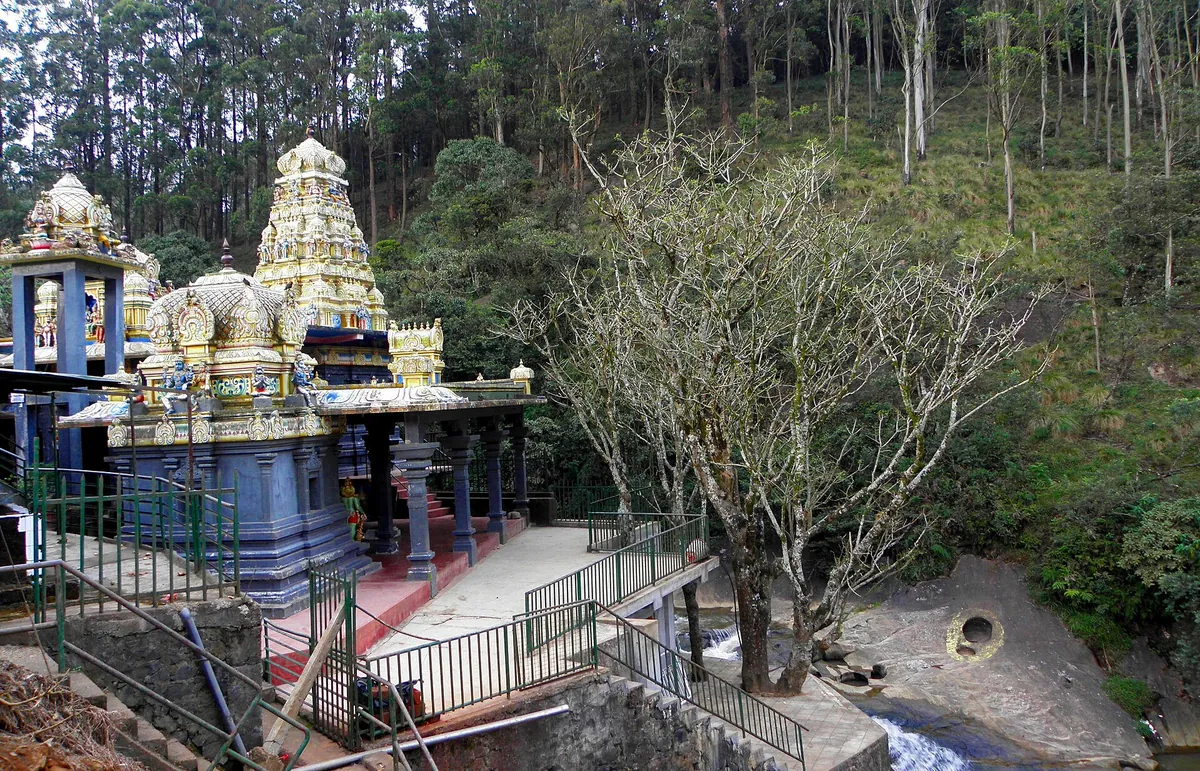
This is the most visited Ramayana site in Sri Lanka and the one most Indian travellers mean when they search for Ashok Vatika.
The temple stands in the village of Seetha Eliya, about 5 km from Nuwara Eliya town on the Nuwara Eliya to Welimada road, and about 1 km from Hakgala Botanical Garden. Tradition says this is where Ravana held Sita captive, in a garden of Ashoka trees. According to the Central Province tourism department, locals say a large Ashoka garden once grew nearby, and the area takes its name from a story that Sita's blindness was cured here.
What to look for:
- The stream running past the temple, where Sita is said to have bathed.
- The stone bench on the rock face, where she is said to have sat.
- The footprints on the rock, which devotees believe were left by Hanuman.
The shrine itself is small and brightly painted, with images of Rama, Sita and Lakshmana. It is one of very few temples anywhere dedicated to Sita.
What happened here, in the story: this is where, in the Sundara Kanda of the Ramayana, Hanuman finally finds Sita after a long and nearly hopeless search of Lanka. He approaches her quietly so as not to frighten her and gives her Rama's ring as proof that he is Rama's messenger. Hanuman offers to carry her back across the sea, but Sita refuses: she will be rescued by Rama himself, not smuggled out of Lanka. Instead she gives Hanuman her chudamani, a jewel from her hair, to take back to Rama as a sign that she is alive. Standing beside the stream, it is easy to see why this is the emotional heart of the whole trail.
How to visit: it is a 10 to 15 minute drive from Nuwara Eliya. Go early in the morning, before the tour buses arrive and while the mist still hangs over the stream. Nuwara Eliya sits at about 1,900 metres, so bring a warm layer even in April.
Distance from Colombo and Kandy: Nuwara Eliya is roughly a 5 to 6 hour drive from Colombo and about 3 hours from Kandy. There is no direct train to the temple. The nearest station is Nanu Oya, about 20 minutes from Nuwara Eliya, on the Colombo to Badulla line.
A story you will hear in Nuwara Eliya: some guides tell Indian visitors that the town's name means "city of light", because people far away saw the glow when Hanuman set Lanka on fire. It is a lovely story, but the more likely meaning of eliya is a plain or open tableland, as in Seetha Eliya and Maha Eliya, the old name for Horton Plains. Nuwara means city.
See it before you go: this video walks through the Seetha Amman Temple and the Ashok Vatika area, including the stream and the rock where Hanuman's footprints are shown.
2. Hakgala Botanical Garden
A short drive past the Seetha Amman Temple, Hakgala Botanical Garden is linked by tradition to the wider Ashok Vatika pleasure garden of Ravana.
Today it is a British-era garden known for roses, ferns and views across to the Uva valley. Combine it with the temple in one morning. Unlike the temples, the garden charges an entry ticket.
3. Divurumpola Temple, The Place Of Sita's Agni Pariksha
Divurumpola is a Buddhist temple about 4 km from Welimada, on the road from Nuwara Eliya towards Badulla. Tradition says this is where Sita underwent the Agni Pariksha, the trial by fire, to prove her purity after her rescue.
Many devotees prefer the term Agni Pravesh, Sita's entry into the fire, to Agni Pariksha. In the Valmiki Ramayana it is Sita herself who asks Lakshmana to light the fire after Rama's harsh words in front of the gathered armies, and Agni, the fire god, returns her unharmed and declares her pure. A common reading is that Rama never doubted her, but wanted every onlooker to see her honour proven. It remains one of the most debated moments in the epic, and the temple is a quiet place to think about it.
The name Divurumpola means "place of the oath" in Sinhala, and the temple still has a role in local life: people come here to swear oaths, and disputes between villagers have been settled by swearing at this temple. From the temple grounds you can look across to the Isthreepura hills, which local tradition associates with the caves where Sita was held.
Allow 45 minutes, and visit on the same day as the Seetha Amman Temple. It is roughly 45 minutes' drive from Nuwara Eliya.
4. Sri Bhakta Hanuman Temple, Ramboda
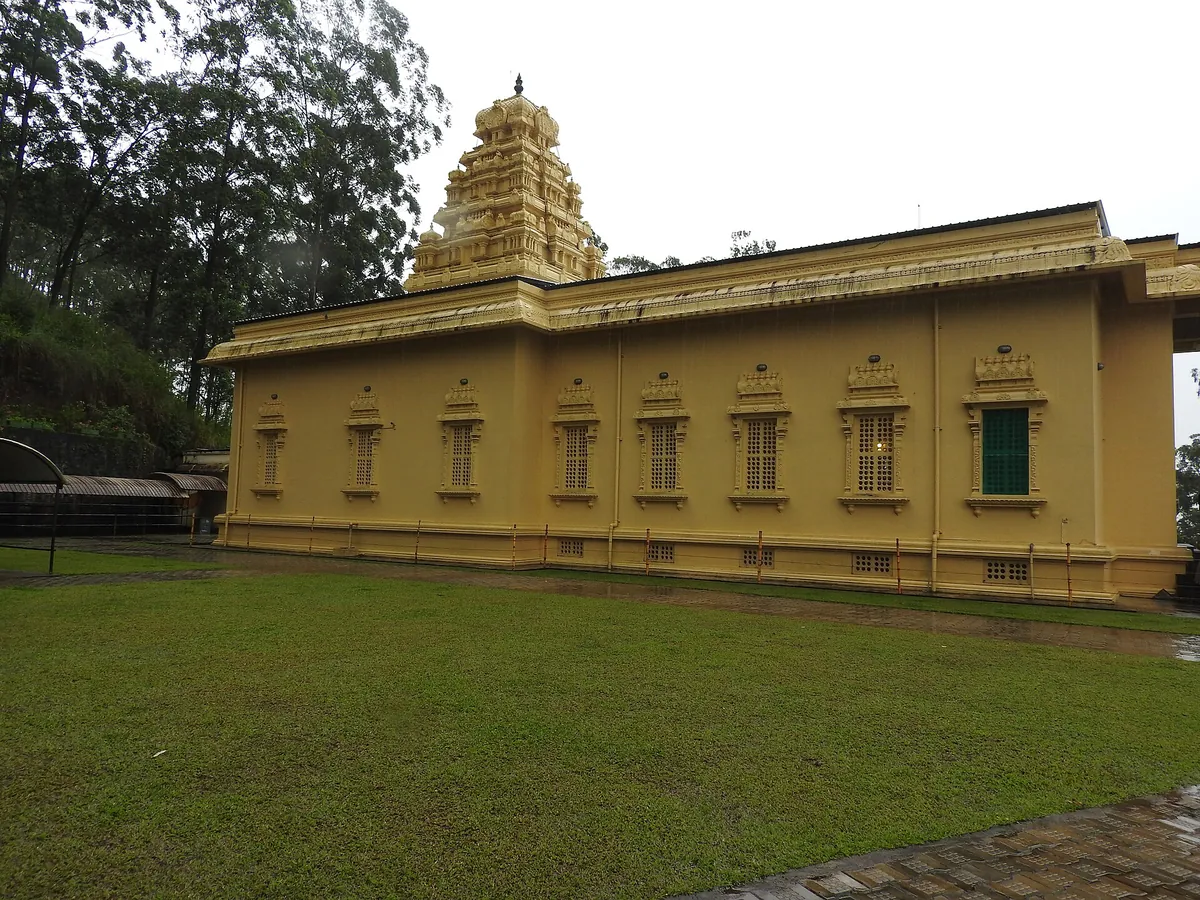
On the road from Kandy up to Nuwara Eliya, the Sri Bhakta Hanuman Temple at Ramboda is the natural first stop of the hill country trail. The temple was built by the Chinmaya Mission of Sri Lanka and consecrated in 2001. Its large black granite Hanuman looks out over the Kotmale valley (Chinmaya Mission).
Tradition says Hanuman searched these hills for Sita, and the name Ramboda is often explained as a link to Rama's forces. The temple is modern, but it is a working place of worship with daily pujas, and many Indian pilgrims make it their first darshan in Sri Lanka.
Good to know: photography of the main idol is not allowed, and you remove your shoes before entering. The Ramboda waterfalls are a few minutes down the road if you want a second stop.
Planning to make a half day of it? This second video follows the same road, from the Hanuman temple to the Ramboda waterfall and a tea estate stop.
5. Ravana Falls, Ella
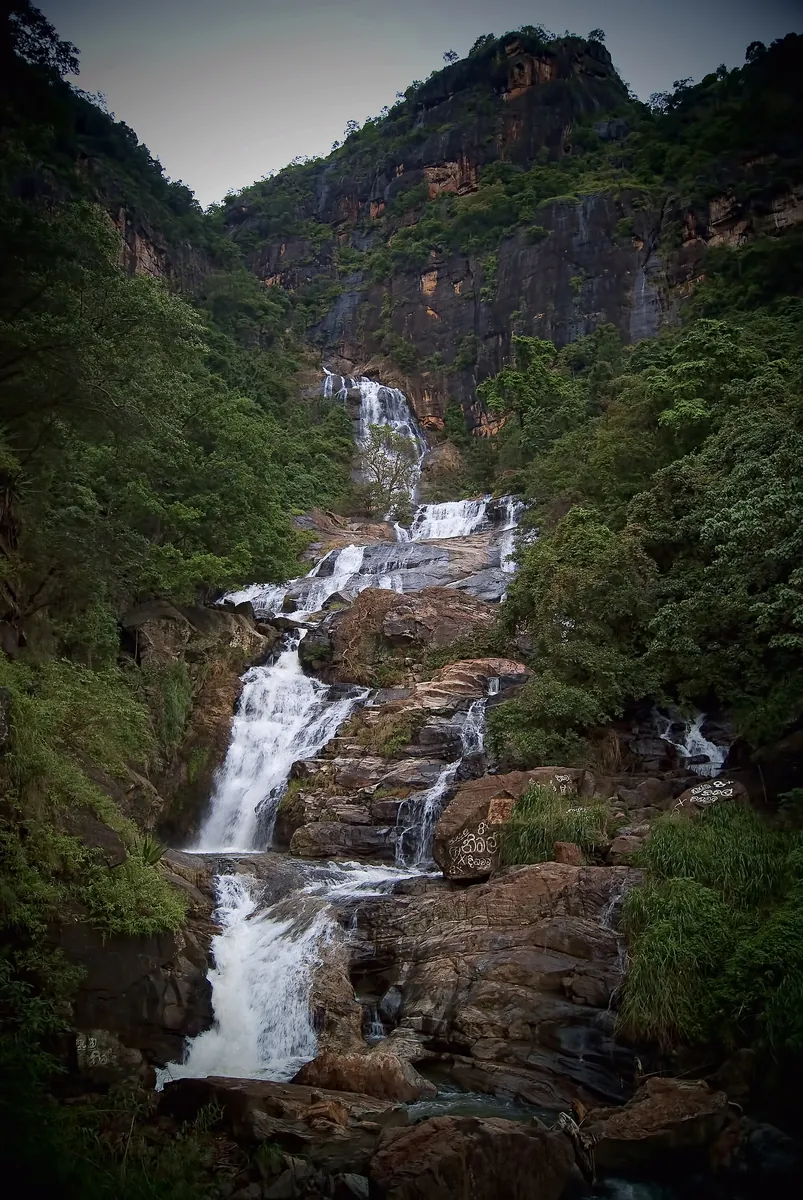
Ravana Falls drops about 25 metres off a rock face right beside the Ella to Wellawaya road, about 6 km from Ella town. Tradition says Ravana hid Sita in the caves behind the falls, and that she bathed in the pool below.
It is a quick stop: you can see the falls from the roadside in a few minutes, and in the dry season you can scramble across the lower rocks. After heavy rain, from about October to January, the falls are at their fullest, and the rocks are slippery, so stay back from the edge.
The falls and the cave are only a short drive apart, and this video covers both, from the roadside falls to the climb up to the Ravana Cave.
6. Ravana Cave, Ella
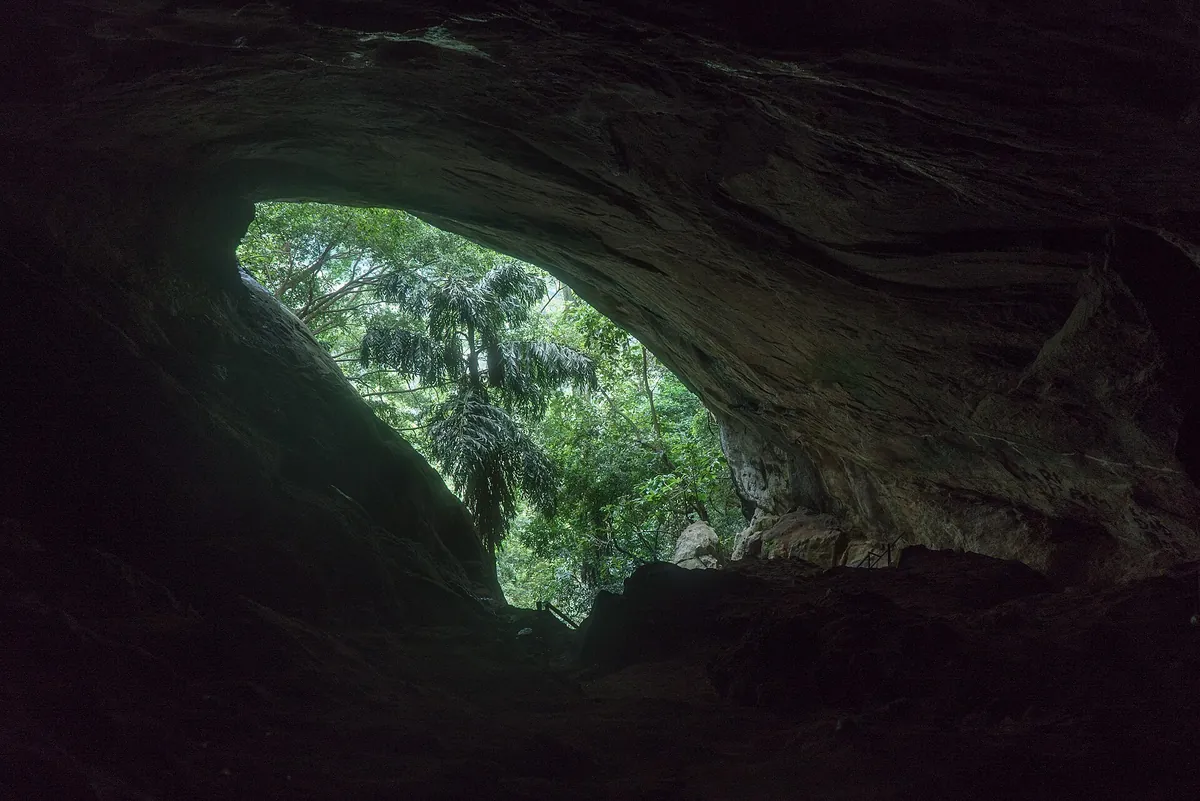
The Ravana Cave sits above the Ravana Ella temple, a short drive from Ella. Local tradition says this cave was part of a network of tunnels Ravana used, and one of the places where Sita was hidden.
Reaching it takes a steep climb up a long flight of stone steps, which takes most visitors 20 to 30 minutes. Wear proper shoes, carry water, and start in the morning before the heat. Inside, the cave opens into a large chamber with a window of light onto the forest.
To see the climb before you do it, this video goes up the steps to the Ravana Cave and inside it.
Ella itself is worth a night or two. If you are building a longer trip around the hill country and the coast, our Sri Lanka itinerary lays out four complete routes with real drive times between each stop.
Watch: The Ramayana Places In Sri Lanka On Video
Before you plan the rest of the route, this video gives a good feel for the hill country sites, from the Seetha Amman Temple to the caves and waterfalls around Ella.
7. Munneswaram Temple, Chilaw
Munneswaram is one of the most important Hindu temples in Sri Lanka, a large Shiva temple complex just outside Chilaw, about 80 km north of Colombo. Tradition says that after the war, Rama stopped here to pray to Shiva and be freed of Brahmahatya Dosha, the sin of killing Ravana, who was a Brahmin.
The main temple is dedicated to Shiva, with shrines to Ganesha, Vishnu and others in the same complex, and unusually a Buddhist shrine within the grounds as well. The temple's big annual festival usually falls in August and September, when the town is crowded with pilgrims.
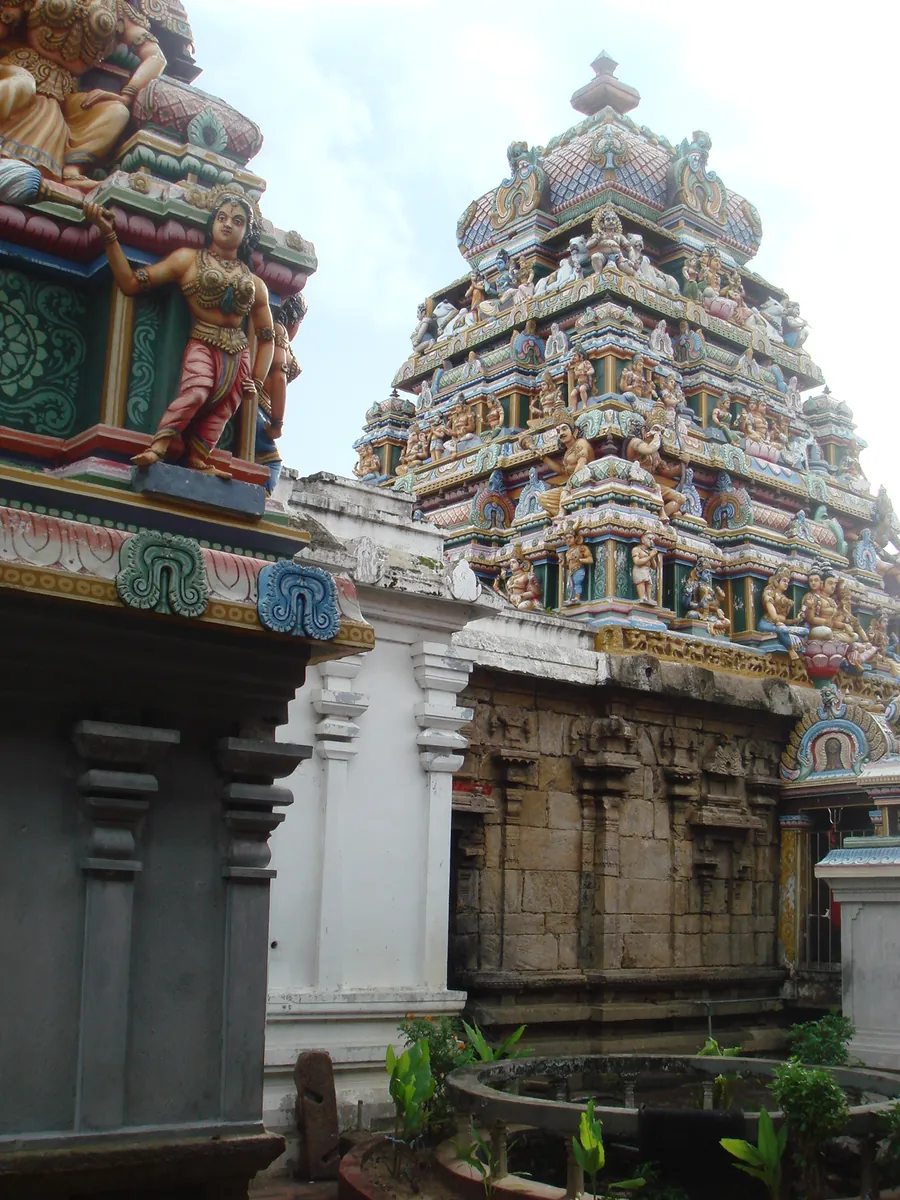
Munneswaram is less than two hours from Colombo airport, so it makes an easy first or last stop. This short video tells its story at the temple itself.
8. Manavari Temple, The Ramalingam
A short drive north of Chilaw, the Manavari temple holds a lingam that tradition says was installed by Rama himself, which is why it is called the Ramalingam. The story is that Shiva advised Rama to install lingams at several places as a remedy for his dosha, and Manavari is often described as the first of them in Sri Lanka.
Most pilgrims visit Munneswaram and Manavari together in a single half day from Colombo or Negombo.
9. Koneswaram Temple, Trincomalee
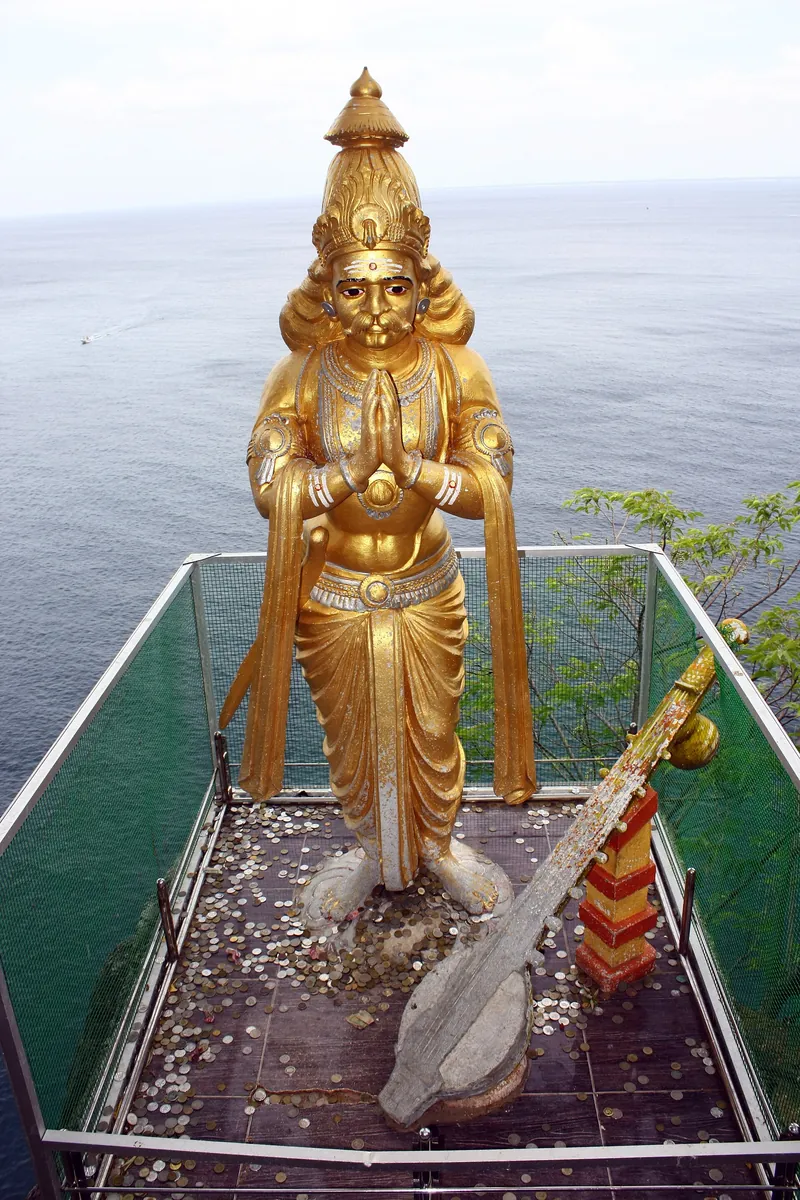
Koneswaram stands on Swami Rock, a cliff above the sea at Trincomalee on the east coast. In the Ramayana tradition, Ravana was a great devotee of Shiva and worshipped here. A deep cleft in the rock beside the temple, called Ravana's Cleft (Ravana Vettu), is said to have been made by Ravana's sword when he tried to move the temple for his ailing mother, until Shiva stopped him.
The temple's setting is part of its power: Swami Rock juts out into the sea, so the water surrounds it on three sides, with the deep natural harbour of Trincomalee on one side and the open Indian Ocean on the other. The old Tamil name of the town, Thirukonamalai, comes from the temple's hill.
A temple destroyed and rebuilt: on 14 April 1622, during the Tamil New Year, Portuguese soldiers destroyed the old temple and used its carved stones to build their fortifications on the headland (Fort Frederick). Priests are said to have buried some of the statues to save them. The present temple was rebuilt and consecrated in 1963. A statue of Ravana worshipping a Shiva lingam stands near the cliff edge.
Visiting tips:
- The road to the temple passes through Fort Frederick, which is still a military area, so keep your camera down near the army buildings and fly a drone only with permission.
- Spotted deer roam freely inside the fort, right up to the temple steps.
- Photography is not allowed inside the inner shrine. Dress modestly and leave your shoes at the entrance.
- The temple closes for part of the afternoon, so check the puja times when you arrive; many visitors come for the evening puja.
Kanniya Hot Springs, nearby: about 10 km outside Trincomalee, seven small square wells of warm water are linked to Ravana too. Local tradition says he struck the ground with his sword seven times to bring up water for his mother's last rites; another version says Vishnu created the springs for him. Each well is said to be a slightly different temperature, and they are only about a metre deep, so you can see the bottom. Archaeologists think they were once part of a bathing complex for a nearby Buddhist monastery. Combine them with Koneswaram in one afternoon.
Is it worth the detour? Trincomalee is about 4 hours from Kandy and 6 hours from Colombo, so it adds a day to the trip. It suits a longer journey that also includes the east coast beaches, best visited from about April to September.
This video visits the clifftop temple, Ravana's Cleft and the statue of Ravana on Swami Rock.
10. Kelaniya Raja Maha Vihara
Kelaniya is a Buddhist temple on the banks of the Kelani River, about 30 minutes from central Colombo. In the Ramayana tradition, after Ravana's death his brother Vibhishana was crowned king of Lanka here. The coronation was performed by Lakshmana rather than Rama, because Rama was still bound by his fourteen years of exile and would not enter a city. Murals at the temple show the coronation, and there is a shrine to Vibhishana, who is still honoured locally as a protector of the western part of the island.
The Vibhishana shrine: inside the temple complex is a shrine (devale) to Vibhishana, who is worshipped here as the patron god of Kelaniya. You will see local families bringing flowers and offerings, and many write their prayers or requests on slips of paper that they hand to the shrine's priest. Stalls outside the gates sell lotus flowers, incense and other offerings if you want to take part.
Why Kelaniya matters to Buddhists too: tradition holds that the Buddha visited Kelaniya on his third visit to Sri Lanka, which makes it the most sacred Buddhist temple in the Western Province. Each January, on Duruthu Poya, the temple holds the Duruthu Perahera, a procession of elephants, drummers and dancers. Vibhishana has his own procession in it, one of the two original parts of the perahera alongside the procession of the Buddha's relics (Daily Mirror on the Duruthu Perahera). If you are travelling in January, it is worth timing your visit for it.
Two views of Vibhishana: Indian visitors are often surprised to learn that Vibhishana is seen differently here. In India he is honoured for choosing dharma over loyalty to his brother. In Sri Lanka he is worshipped as a god at Kelaniya, but some Sri Lankans also see him as the brother who helped bring about Ravana's fall, while Ravana himself is remembered by many as a great king and a devotee of Shiva rather than a villain. It is a good reminder that the Ramayana is told in more than one way, and worth being sensitive to when you talk about it with local people.
It is an easy stop on your first or last day, because it lies between Colombo and the airport, and Kelaniya also has its own railway station. The shrine usually closes for a few hours in the middle of the day, so go in the morning or late afternoon. This video looks round the temple and its Vibhishana shrine.
11. Ram Setu (Adam's Bridge), Mannar
Ram Setu, called Adam's Bridge in English, is the chain of limestone shoals and sandbanks between Rameswaram in Tamil Nadu and Mannar Island in Sri Lanka. It is about 48 km long and the sea over it is very shallow (Encyclopaedia Britannica). In the Ramayana, this is the bridge Rama's army of vanaras built to cross to Lanka.
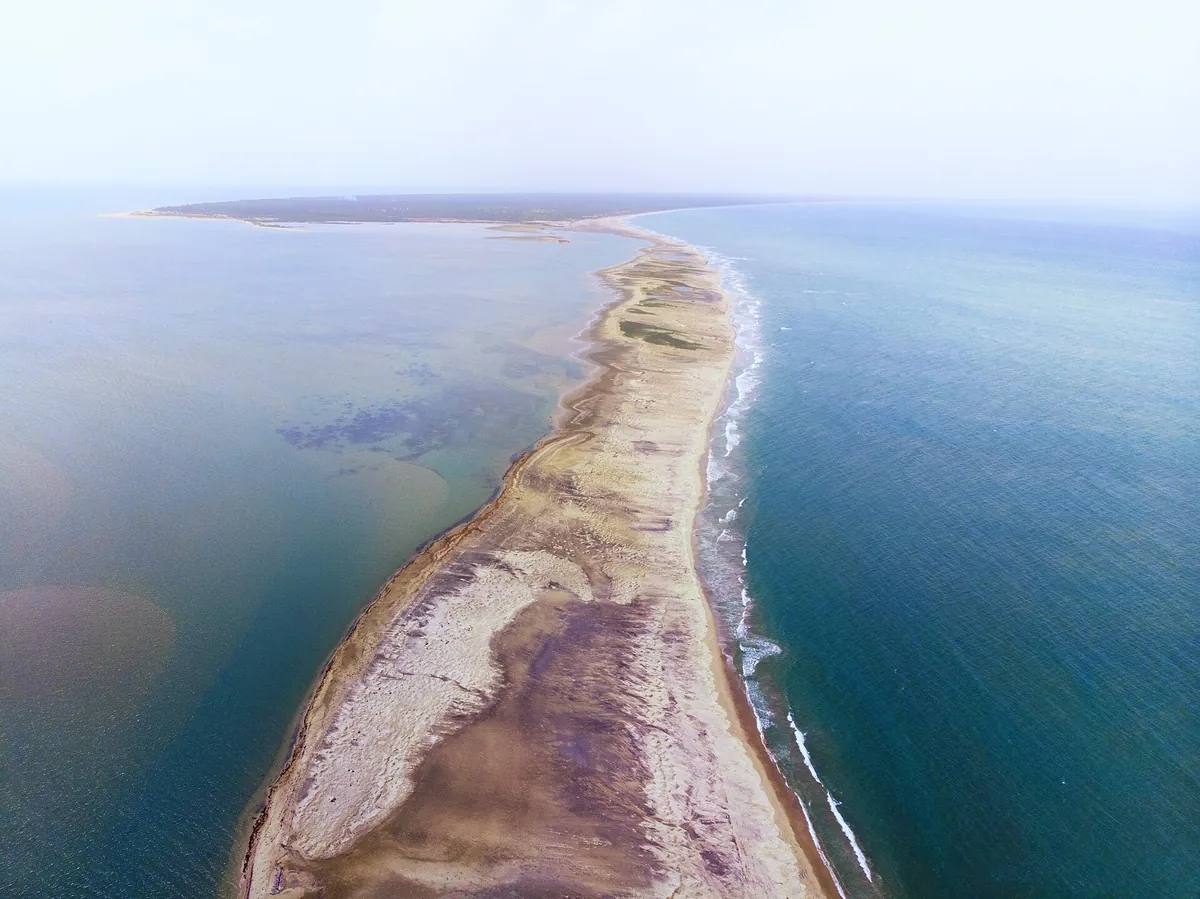
Many names, many stories: Indians know it as Ram Setu or Nala Setu, after the vanara Nala who is said to have built it. The English name, Adam's Bridge, comes from a Muslim tradition that Adam crossed here from India on his way to Adam's Peak, and near Talaimannar a Muslim shrine has two very long graves that local people believe are those of Adam and Eve. Geologists see a chain of sandbanks and shoals that may once have been a land link between the two countries. Few places in Sri Lanka carry so many beliefs at once.
Talaimannar and the lost crossing: Talaimannar is the closest point in Sri Lanka to India, roughly 25 to 30 km from Dhanushkodi. For decades a ferry ran between the two from the old Talaimannar pier, and travellers from Chennai could take the Boat Mail train to Dhanushkodi and cross by steamer. The great cyclone of December 1964 destroyed Dhanushkodi and its railway line, and the regular crossing has not come back. Today you can see the old pier and the Talaimannar lighthouse, and on a very clear day some visitors say they can make out the Indian coast.
Can you go out to the sandbanks? Access is controlled by the Sri Lanka Navy, which has a base near the pier. In the past the Navy ran public boat trips out to the first sandbanks when the sea was calm, but recent visitors report that permission is now usually refused and that you can only go as far as the beach near the lighthouse. Ask at Talaimannar when you arrive, and plan to see Ram Setu from the shore.
From the Sri Lankan side, you view it from Talaimannar at the western tip of Mannar Island. Mannar is far from the rest of the trail, about 6 to 7 hours' drive from Colombo, so most travellers only include it on a longer trip through the north, often combined with Jaffna. If you cannot make the journey, this video shows the trip out to Ram Setu from the Sri Lankan side.
12. Ussangoda And Rumassala, On The South Coast
Two sites on the south coast are tied to Hanuman.
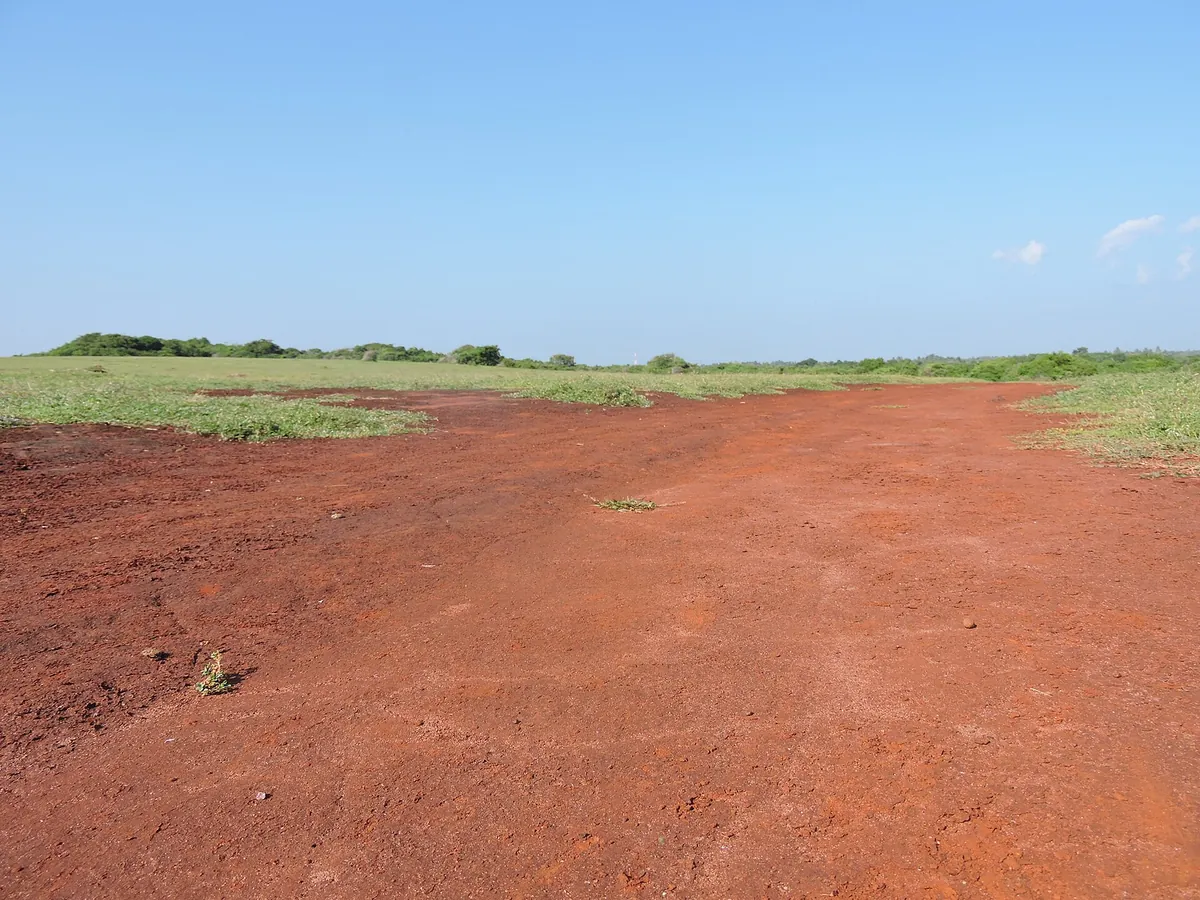
Ussangoda, near Ambalantota, is a flat plateau of strange reddish soil above the sea, now a national park managed by the Department of Wildlife Conservation. Tradition says this is land Hanuman burned with his flaming tail, and some accounts call it the landing ground of Ravana's flying chariot, the Pushpaka Vimana. In the story, Ravana orders Hanuman's tail to be set alight and paraded through Lanka as an insult; the fire does not hurt him, and he uses the burning tail to set the city ablaze. Look around and you will notice that the green scrub stops at the edge of the bare red ground. Believers see Hanuman's fire in that; others put the strange soil down to a meteor strike long ago.
Rumassala, the forested hill above Unawatuna near Galle, is said to be a fragment of the Himalayan mountain Hanuman carried to Lanka. In the Yuddha Kanda, Lakshmana and the vanara army lie wounded, and Jambavan sends Hanuman to the Himalayas for four healing herbs: Mritasanjivani, Vishalyakarani, Suvarnakarani and Sandhani. Unable to pick them out, Hanuman lifts the whole mountain and flies back with it, and pieces are believed to have fallen along the way. Local belief holds that some plants on Rumassala grow nowhere else on the island. The Japanese Peace Pagoda on top has wide views over the bay.
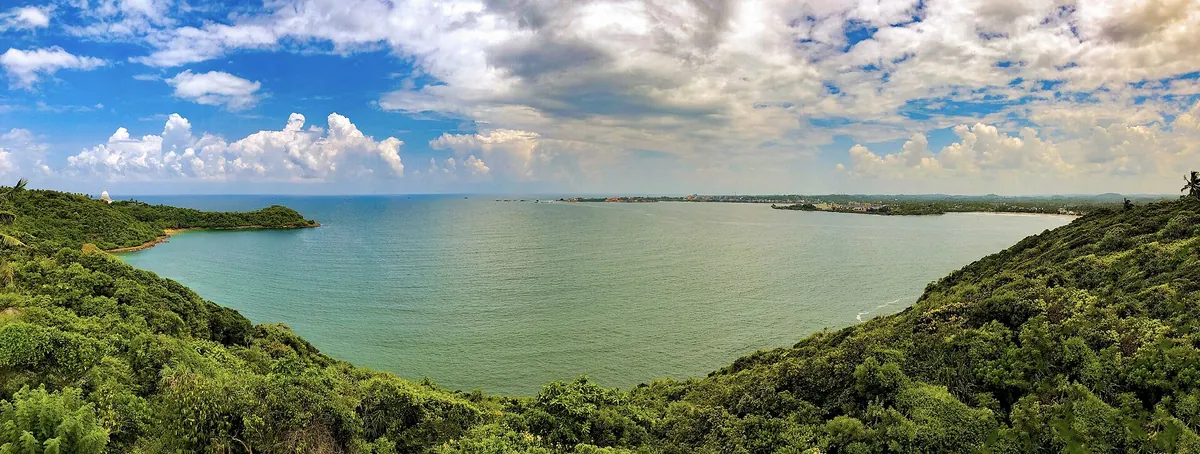
Both fit naturally into the drive back to Colombo along the south coast. This Sri Lankan travel show explores Rumassala, its jungle paths, the Peace Pagoda and the beaches below the hill.
More Places Linked To The Ramayana
Dunuwila, in the hills north-east of Kandy on the way towards Wasgamuwa National Park, is where Sri Lankan tradition says Rama fired the Brahmastra that killed Ravana. The name is read as dunu (bow) and vila (lake), and nearby Laggala is linked to "Ilakka Gala", the target rock. There is no temple or visitor site to speak of, and the link rests on the place names rather than any historical evidence, so it is a stop for keen pilgrims rather than a fixed part of the trail.
Sigiriya is linked by some believers to Ravana's palace, but archaeologists date the rock fortress to King Kashyapa in the 5th century AD. It is worth visiting for its own sake.
Watch: Inside Ravana's Lanka
This second video visits Ashok Vatika at Seetha Eliya, the Ravana Cave near Ella and Sigiriya.
A 7-Day Ramayana Trail Route
This route covers the main sites without backtracking, starting and ending at Bandaranaike International Airport in Colombo. Drive times are typical times by car and vary with traffic and stops.
| Day | Route | Ramayana sites | Night |
|---|---|---|---|
| 1 | Airport to Chilaw (about 1.5 hours) | Munneswaram, Manavari | Chilaw or Negombo |
| 2 | Chilaw to Kandy (about 3 hours) | Temple of the Tooth in Kandy (not Ramayana, but worth it) | Kandy |
| 3 | Kandy to Nuwara Eliya (about 3 hours) | Sri Bhakta Hanuman Temple, Ramboda | Nuwara Eliya |
| 4 | Around Nuwara Eliya | Seetha Amman Temple, Hakgala, Divurumpola | Nuwara Eliya |
| 5 | Nuwara Eliya to Ella (about 2.5 hours) | Ravana Falls, Ravana Cave | Ella |
| 6 | Ella to the south coast (about 4 hours) | Ussangoda, Rumassala | Galle or Unawatuna |
| 7 | Galle to Colombo and the airport (about 2.5 hours) | Kelaniya Raja Maha Vihara | Fly home |
Add two days for Koneswaram in Trincomalee, or two to three days for Mannar and Jaffna in the north.
The easiest way to cover this route is with a car and driver, because the temples are spread across small roads where buses are slow and trains do not reach. This is exactly what we do at Wonder of Ceylon. We arrange a private air-conditioned car or van with an English-speaking driver who knows the temple roads, the darshan and puja times, and where to find good vegetarian food along the way. We can follow the 7-day route above or build a trail around your own dates, group size and budget, with hotels if you need them.
Tips For Indian Travellers On The Ramayana Trail
Visa: Indian citizens get a free 30-day ETA, but you must apply online before you fly.
Flights: most visitors fly into Colombo, with direct flights from several Indian cities including Chennai, which is a little over an hour away.
Currency: Indian rupees are not generally accepted in shops. Carry US dollars or use a card to withdraw Sri Lankan rupees from ATMs in Colombo, Kandy or Nuwara Eliya.
Vegetarian food: finding vegetarian meals is easy in Colombo and Kandy, and South Indian vegetarian restaurants are common in Colombo's Wellawatte area. In smaller towns, ask your driver or hotel. Most Sri Lankan rice and curry can be made fully vegetarian on request.
Temple etiquette:
- Cover your shoulders and knees. Carry a shawl or sarong.
- Remove your shoes and hats before entering. Socks help on hot stone floors.
- Ask before photographing people, and never take photos of idols where signs say not to.
- At Buddhist temples such as Kelaniya and Divurumpola, do not pose with your back to a Buddha statue.
Weather: the hill country (Nuwara Eliya, Ella) is driest from about January to April, and cold at night all year. Chilaw and the west coast are best from December to March. Trincomalee and the east coast are best from April to September. Our guide to the best time to visit Sri Lanka shows the weather month by month for each region.
Budget: temples are free to enter, though donations are welcome. Hakgala Botanical Garden and Ussangoda charge entry fees. To estimate the whole trip, including the driver, hotels and meals, use the Sri Lanka trip cost calculator.
FAQs About Ramayana Places In Sri Lanka
Where Is Ashok Vatika In Sri Lanka?
Ashok Vatika is traditionally placed at Seetha Eliya, about 5 km from Nuwara Eliya on the road to Welimada. The Seetha Amman Temple marks the spot where Sita is believed to have been held, and nearby Hakgala Botanical Garden is linked to the wider garden. It is about 5 to 6 hours by road from Colombo and about 3 hours from Kandy.
How Many Ramayana Places Are There In Sri Lanka?
Lists vary, and some mention more than 50 sites linked to the Ramayana by tradition. Sri Lanka Tourism currently recommends about 20 as easy to visit. This guide covers the 12 most visited, which together make a trip of about a week, or longer if you add Trincomalee and Mannar.
Where Did Sita Stay In Lanka?
Tradition places Sita's captivity in the hill country around Nuwara Eliya. The Seetha Amman Temple at Seetha Eliya is believed to mark the Ashok Vatika garden, and caves near Ella and the Isthreepura hills near Welimada are also linked to places where Ravana is said to have hidden her.
How Many Days Do You Need For A Ramayana Tour In Sri Lanka?
About 7 days covers the main sites: Munneswaram and Manavari near Chilaw, the Hanuman Temple at Ramboda, the Seetha Amman Temple and Divurumpola near Nuwara Eliya, Ravana Falls and Ravana Cave near Ella, and Kelaniya near Colombo. Add 2 days for Koneswaram in Trincomalee, or 2 to 3 days for Ram Setu at Mannar.
Can You See Ram Setu From Sri Lanka?
Yes. On the Sri Lankan side, Ram Setu, also called Adam's Bridge, begins at Talaimannar on Mannar Island, where the sandbanks stretch out towards India. Mannar is about 6 to 7 hours by road from Colombo, so most visitors include it only on a longer trip through northern Sri Lanka.
Is Sigiriya Ravana's Palace?
Some believers say Sigiriya was Ravana's palace, but historians and archaeologists date the rock fortress to King Kashyapa in the 5th century AD. It is a UNESCO World Heritage Site and well worth visiting either way, but it is not usually part of a traditional Ramayana pilgrimage.
What Is The Best Time For A Ramayana Tour In Sri Lanka?
January to April is the best time for most of the trail, because the hill country around Nuwara Eliya and Ella is driest then and the west coast near Chilaw is sunny. If you want to include Koneswaram in Trincomalee, April to September suits the east coast better. Munneswaram's main festival usually falls in August and September.
Do Indians Need A Visa To Visit The Ramayana Sites In Sri Lanka?
Yes. Indian citizens need an Electronic Travel Authorization, or ETA, but for a 30-day tourist trip it is now free. You still have to apply online on the official portal before you fly, because airlines check for an approved ETA at check-in.
Planning Your Ramayana Trail
The Ramayana trail is one of the most rewarding ways to see Sri Lanka, because it takes you through the cool tea hills, the waterfalls of Ella and the temple towns of the coast, not just the usual beach circuit. Plan around the hill country, give yourself a week, and travel with a driver who knows the temple roads. If you want help putting the route together, or quotes from licensed agencies that specialise in Ramayana tours, message our team on WhatsApp and we will plan it with you.
Related Articles

30 Unique Sri Lanka Trip Ideas For Couples: Romantic Escapes And Adventures
The best couples' trips in Sri Lanka combine two or three experiences: a tea bungalow in Hatton, a safari in Udawalawe and a quiet beach in Tangalle. 30 ideas with suggested stays, costs and local tips.
Read More
Best Time to Visit Sri Lanka: A Month-by-Month Guide by Region
The best time to visit Sri Lanka depends on which coast you want: December to April for the south, west and hill country, May to September for the east. Weather, crowds and the best region for every month, with official climate and arrivals data.
Read More
Driving in Sri Lanka as a Tourist: The 2026 Self-Drive Guide
Can tourists drive in Sri Lanka? Yes, with the right permit. The IDP recognition rule most visitors miss, road rules, how safe it is, the best routes, and when a private driver makes more sense.
Read MoreWritten by
Ashan LokugeTravel writer
Ashan Lokuge is a content writer, SEO specialist and software engineer at Wonder of Ceylon. He travels all nine provinces of Sri Lanka to research every guide in person, focusing on the places most travel guides miss.
View all posts by Ashan